

📊 Chapter 1 Executive Briefing: Macro Sizing & OTT Metrics
- Ecosystem Valuation: Exploded into a $22.6 Billion dual-engine media economy across long-form SVOD and short-form micro-drama platforms.
- The Standard Metric: True industry engagement is benchmarked by Yunhe Data V30 (30-day Effective Playback) rather than raw impressions.
- Platform Oligopoly: Dominated by the BAT+M cluster (iQIYI, Tencent Video, Youku, Mango TV) shifting from volume to capital discipline.
- The Core Strategic Friction: A profound cultural and structural translation gap causing early-episode viewer drop-off in Western B2B markets.
📊 C-Drama Industry Report: Executive Briefing & FAQ
What is the operational scope of this market intelligence report?
This report functions as a structural macro-economic analysis of the mainland Chinese television and digital short-form sectors. It bypasses consumer-facing recaps or content reviews to focus exclusively on B2B revenue architectures, upstream web-novel intellectual property (IP) pipelines, domestic streaming platform balance sheets, and cross-border distribution models.
What methodological foundations govern the dataset?
The quantitative data is built upon a triangulated architecture of verified institutional disclosures. Core metrics are synthesized directly from primary corporate earnings filings (iQIYI SEC Form 20-F, Tencent and Alibaba HKEX disclosures) paired with third-party domestic data processors including Media Partners Asia (MPA), Yunhe Data (V30 benchmarks), DataEye, and Sensor Tower.
Who authored this analysis and what is the strategic objective?
The report is compiled by Gergana Toleva, leveraging nine years of professional expertise within global B2B language localization markets. The objective is to fill a profound informational vacuum in English-language media criticism, providing western buyers, corporate content strategists, and media investors with an objective framework to assess Chinese entertainment assets.
Is this research a static asset or a rolling publication?
This project is organized as an active, rolling multi-chapter digital asset. Chapters are published incrementally as primary research cycles conclude. Current live entries include Chapter 1 (Macro Market Sizing & OTT Platforms) and Chapter 2 (Production Ecosystems & IP Flow Architecture), with subsequent sectors following a strict release roadmap.
Which structural segment is recommended for initial onboarding?
Onboarding pathways depend strictly on executive focus. Media buyers and corporate analysts looking for fiscal evaluations and scale charts should review the initial macro-sizing segments. Strategists seeking to unpack contract mechanics, production studio workflows, and rights acquisitions should proceed directly to the production architecture modules.
How does this report integrate with the website’s primary content?
This intelligence asset serves as the institutional counterpart to the blog’s micro-level cultural entries. While individual drama analyses dissect a specific work through a cinematic or narrative lens, this report examines the foundational capital allocations, regulatory boundaries, and corporate pipelines that allow those series to be manufactured in the first place.
Bridging Chinese Production Architecture and Western Market Expansion
Preface by Author
The current report is my personal attempt to fill in a gap that I find very curious from a professional perspective and might be useful to other professionals beyond cultural differences and general noise on popular actors.
Right now due to my own curiosity I have not found a suitable resource in English that can provide a general perspective of the c-drama industry and production.
As I am equally fascinated by culture differences and actors’ dynamics, the same goes for how the industry is structured, what its size is and how it approaches foreign markets.
The report is gathered by data which is my understanding of useful information when one is judging a market assessing it or taking a look at how it operates.
The data generated is from available online resources both in English and in Chinese language and by using some state of artificial intelligence to help me bridge the gap for the Chinese language resources.
As Chinese drama is becoming more and more popular overseas it is also a point of interest on how it will develop, how it will enter in western markets and how it will adapt to Western audiences.
For me it is particularly interesting how Chinese production companies and industry in general is going to adapt or choose to export its own models of operation as well as how the Western market is going to respond to it in the future.
I hope this report it’s going to be useful for other professionals not only in the entertainment industry but to other professionals who are looking for credible data or a different and more structured perspective on the Chinese production environment.
I am fully aware that this being a first attempted this there might be data that will need either correction or reiteration so any feedback you have a reader feel free to provide by any means you choose.
Thank you very much for reading and I I hope this report is going to serve its purpose for you.
Yours,
Gergana Toleva
The G.Blog
CHAPTER 1: MACRO INDUSTRY OVERVIEW
1.1 The Dual-Engine Global Expansion Model (SVOD vs. Short-Form)
The global Chinese drama ecosystem has evolved beyond a monolithic content export model into a dynamic, dual-engine media economy. This structural evolution is anchored by two distinct operational and commercial vectors that address different consumption habits, price sensitivities, and distribution channels:
- Long-Form Premium SVOD (Traditional C-Drama): These are high-budget (RMB 100M–300M / $14M–$42M) S/S+ tier productions spanning 24 to 40 episodes. Grounded in intellectual property (IP) adapted from online literature, star power (Liuliang), and cinematic visual effects, these tentpole series serve as primary drivers for platform subscriber retention on proprietary Direct-to-Consumer (D2C) apps (WeTV, iQIYI International) and major B2B licensing deals with global platforms (Netflix, Viki, YouTube).
- Vertical Micro-Dramas (短剧 / Mobile Apps): Fast-paced, mobile-native serialized content (60–100 episodes per series, 1–2 minutes per episode) engineered for short attention spans, algorithmic paywalls, micro-transactions, and AI-accelerated workflows. Proprietary platforms such as ReelShort, DramaBox, ShortMax, and FreeReels deploy these high-velocity narrative formats directly into international markets, establishing a parallel digital revenue stream.
📊 Chapter 1 Executive Briefing: Macro Sizing & OTT Metrics
- Ecosystem Valuation: Exploded into a $22.6 Billion dual-engine media economy across long-form SVOD and short-form micro-drama platforms.
- The Standard Metric: True industry engagement is benchmarked by Yunhe Data V30 (30-day Effective Playback) rather than raw impressions.
- Platform Oligopoly: Dominated by the BAT+M cluster (iQIYI, Tencent Video, Youku, Mango TV) shifting from volume to capital discipline.
- The Core Strategic Friction: A profound cultural and structural translation gap causing early-episode viewer drop-off in Western B2B markets.
| Metric / Feature | Long-Form C-Drama (OTT SVOD) | Vertical Micro-Drama (短剧 / Apps) |
| Domestic Budget | $10M – $45M | $20K – $150K |
| Export Vector | D2C Apps & B2B Licensing | Direct App Monetization |
| Revenue Model | Subscriptions & Advertising | Micro-In-App Purchases (IAP) & Programmatic Ads |
This structural shift, combining disciplined domestic streaming operations (“quality over quantity”) with rapid international growth in short-form micro-drama apps, elevated the overall valuation of the C-drama ecosystem to $22.6 Billion. Overseas revenue is emerging as an important expansion vector for Chinese production houses and foreign media partners alike.
1.2 Market Sizing, Global Export Trajectories, and Forecasts (2021–2030)
While China’s domestic long-form streaming space has entered a mature phase focused on margin stability and Average Revenue per Membership (ARM) rather than raw subscriber volume, the export layer and short-form micro-drama sectors continue to experience rapid growth.
Global C-Drama Market Sizing & Projections
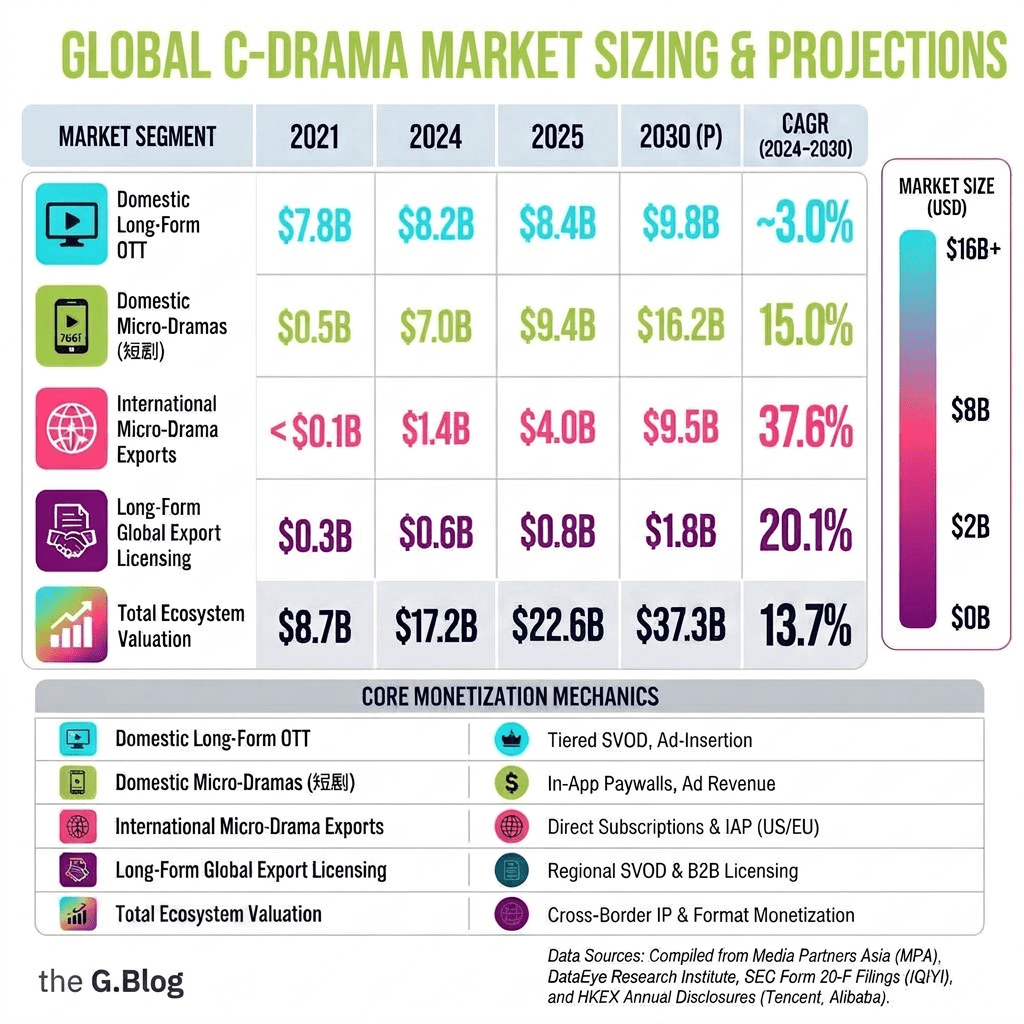
Data Sources: Compiled from Media Partners Asia (MPA), DataEye Research Institute, SEC Form 20-F Filings (iQIYI), and HKEX Annual Disclosures (Tencent, Alibaba).
1.3 Domestic Platform Oligopoly and Yunhe V30 Content Benchmarks
Domestic distribution remains consolidated under four dominant streaming platforms, collectively referred to as BAT + M:
| Platform | Ticker / Exchange | Key Strategic Focus | Primary Metrics & Financial Traits |
| iQIYI | NASDAQ: IQ | ARM Maximizer | Cost Discipline |
| Tencent Video | HKEX: 0700 | IP Monolith | 117M+ Subscribers |
| Youku | HKEX: 9988 | ROI Rationalization | Loss Narrowed |
| Mango TV | SZSE: 300413 | In-House Production | High Profitability |
The Performance Benchmark: Yunhe Effective Playback
Domestic industry evaluation has shifted away from vanity impression metrics toward Yunhe V30 (30-day Effective Playback / 有效播放). This standardized index measures true viewer engagement, reflecting market consolidation that focuses audience attention on a select group of flagship titles each season.
YUNHE DATA V30 TIERS (30-DAY AVERAGE VIEWS PER EPISODE)
| Content Tier | Viewership Benchmark (per episode) | Notable Example / Notes |
| S+ Mega-Hit (Blockbuster) | > 50M – 110M+ views | Joy of Life 2 |
| S-Tier Hit | 30M – 50M views | — |
| A-Tier / Standard Content | 18M – 30M views | — |
| Underperforming / Cold | < 18M views | — |
- S+ Mega-Hits (>50M–100M+ views/ep V30): Exceptionally rare, capped at 1 to 3 titles per year. Major releases like Joy of Life Season 2 reached an industry-record 110 Million V30 average episode playback, accumulating over 4.51 Billion cumulative views.
- S-Tier Hits (30M–50M views/ep V30): Primary drivers of subscriber acquisition, ad pricing, and international licensing interest (The Double, The Tale of Rose, Blossoms Shanghai).
- A-Tier Content (18M–30M views/ep V30): Represents the baseline commercial viability threshold. Platforms are systematically scaling back capital allocations for domestic projects below this mark to reallocate resources toward micro-dramas and global direct-to-consumer apps.
1.4 Granular Financial Balance Sheet Analysis by Platform
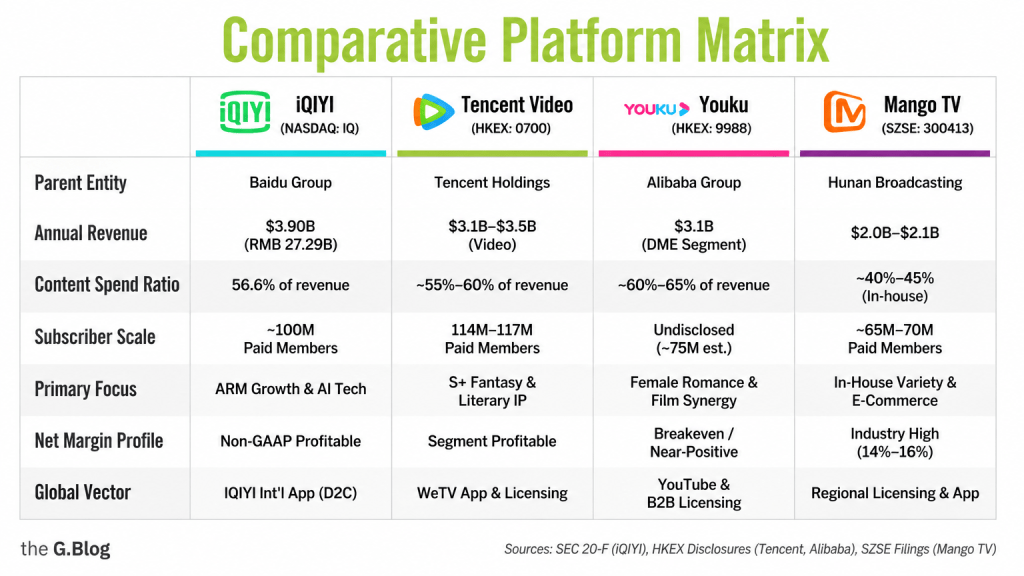
Understanding the competitive landscape requires evaluating the operational balance sheets and strategic focuses of the major streaming operators:
1.4.1 iQIYI (NASDAQ: IQ): Operating Discipline & Overseas Expansion
iQIYI functions as China’s primary standalone, publicly traded long-form streaming platform.
- Financial Performance: Generated RMB 27.29 Billion ($3.90B) in total annual revenue, delivering a Non-GAAP operating profit of RMB 638.9 Million ($91.4M). Membership services contributed RMB 16.81 Billion ($2.40B), online advertising yielded RMB 5.19 Billion ($742.6M), and content distribution brought in RMB 2.50 Billion ($357.1M).
- Overseas Growth Engine: International membership revenue expanded by over 30% YoY (with Q4 international growth reaching 40% YoY). High-growth export territories like Brazil, Mexico, and Indonesia achieved YoY membership growth exceeding 80%.
- AI Production Pipeline: Deploys its proprietary production platform, Nado Pro, which leverages foundational Large Language Models to streamline script evaluation, shooting schedules, and post-production localization workflows.
iQIYI REVENUE MIX (RMB BILLIONS)
| Revenue Stream | Revenue (RMB) | Share (%) |
| Membership Services | 16.81B | 61.6% |
| Online Advertising | 5.19B | 19.0% |
| Content Distribution | 2.50B | 9.2% |
| Other Revenues | 2.79B | 10.2% |
| Total | 27.29B | 100.0% |
1.4.2 Tencent Video (Tencent Holdings – HKEX: 0700): The IP-Backed Scale Leader
Tencent Video maintains scale leadership in Chinese SVOD, supported by deep integration with parent company Tencent’s IP ecosystem.
- Scale & Revenue: Commands a market-leading base of 114 Million to 117 Million paid subscribers, with full video platform revenues running at RMB 22 Billion–25 Billion ($3.1B–$3.5B) annually.
- Upstream Synergy: Direct alignment with China Literature (阅文集团) grants Tencent Video first-look access to online literary IPs across fantasy (Xianxia), martial arts (Wuxia), and historical romance genres.
- Global App Strategy: Operates WeTV as its primary overseas D2C delivery arm, focusing heavily on localized content distribution across Southeast Asia and North America.
1.4.3 Youku (Alibaba Group – HKEX: 9988): ROI Rationalization & B2B Exporting
Youku serves as the central video pillar of Alibaba’s Digital Media and Entertainment (DME) division.
- Financial Profile: Alibaba DME reports annual segment revenue of RMB 22.3 Billion ($3.1B), with Youku steadily narrowing operating losses toward breakeven.
- Content Focus: Focuses on female-demographic costume dramas (The Double, Lighter & Princess) to maximize viewer engagement and commercial brand placement relative to overall production spend.
- Distribution Strategy: Combines direct content licensing to global streaming platforms with high-volume deployment on official YouTube channels to build top-of-funnel brand reach.
1.4.4 Mango TV (Mango Hypermedia – SZSE: 300413): The High-Margin In-House Engine
State-backed Mango TV (controlled by Hunan Broadcasting System) consistently yields the highest operating margins in the domestic streaming sector.
- Financial Profile: Consolidated annual revenue reaches RMB 14.0 Billion–15.0 Billion ($2.0B–$2.1B), maintaining net profits between RMB 2.0 Billion–2.4 Billion ($280M–$340M).
- Margin Structure: Achieves industry-leading operating margins of 14%–16% by operating an internal network of over 50 production studios, eliminating middleman production markups.
- E-Commerce Integration: Converts viewership directly through its Xiaomang E-Commerce (小芒电商) platform, selling apparel, cosmetics, and IP merchandise featured within its programming.
MANGO TV VERTICAL INTEGRATION vs. TRADITIONAL OTT MODEL
| Model | Content & Distribution Pipeline | Financial & Margin Profile |
| Mango TV | In-House Studios (50+) ──► Platform ──► E-Commerce Purchase | Low margin leakage, 14–16% Net Profit Margin |
| Traditional | Independent Studio ──► Platform Acquisition ──► Ad/SVOD | Third-party markup, variable margin profile |
1.5 Macro Structural Shifts & Export Dynamics
Two macroeconomic forces are reshaping production pipelines and global export strategies:
1. Regulatory Framework & Supply Discipline
The National Radio and Television Administration (NRTA) enforces a 40-episode ceiling per season for long-form dramas. This policy successfully eliminated episode-padding practices, encouraging tighter narrative pacing, multi-season franchise development (Strange Tales of Tang Dynasty), and clearer licensing packages for international buyers.
2. The Micro-Drama Supply Chain & Global AI Deployment
Production costs for vertical micro-dramas range from $400,000 for period costume pieces down to $20,000 for modern settings. Overseas micro-drama app revenue surged to over $4.0 Billion, led by platforms such as ReelShort, DramaBox, and FreeReels. Chinese media publishers are integrating AI video generation models (Seedance 2.0, Kling 3.0, Vidu) into foreign dubbing, script translation, and visual workflows, compressing localized asset delivery costs by up to 80%.
1.6 Dual-Executive Strategic Guidelines & Navigation Framework
To bridge the operational gap between Chinese production entities and Western distribution channels, industry leaders should evaluate the market through a dual lens:
| Executive Perspective | Operational Focus | Strategic Priorities |
| For Chinese Production Houses | Outbound Global Expansion |
• Shift from B2B sales to D2C apps • Optimize localization workflows • Scale micro-drama monetization |
| For Western Media Executives | Content Navigation & Import |
• Benchmark S-tier IP acquisition • Understand Chinese platform ROI • Track vertical short-drama formats |
Points of Interest for Chinese Media & Production Executives (Maximizing Global ROI)
- Direct Platform Ownership vs. Third-Party Sales: Relying solely on third-party B2B content sales caps long-term financial upside. Building D2C platform presence (WeTV, iQIYI International) or launching localized micro-drama apps preserves user data and captures long-tail subscription value.
- Standardized Localization Workflows: Linguistic and cultural friction remains a primary point of viewer drop-off in Western markets. Establishing standardized IP glossaries and deploying AI-assisted dubbing workflows early in production can reduce post-production localization timelines by up to 50%.
- Format Diversification: High-budget long-form titles build brand equity and cultural prestige, while agile short-form micro-dramas generate fast cash-flow cycles that can fund broader international marketing spend.
Points of Interest for Western Media Executives & Buyers (Navigating the Ecosystem)
- Licensing Valuation Arbitrage: Chinese streaming platforms prioritize direct foreign currency cash-flow to offset domestic production overhead. Foreign buyers can license high-budget ($30M+) period fantasy and costume series at favorable cost-per-hour metrics compared to Western originals.
- Evaluating S+ Performance Signals: Assessing Chinese IP value requires looking beyond surface social metrics. Relying on verified performance indicators like Yunhe V30 metrics, Douban score distributions, and Qidian reader retention provides a data-backed foundation for content acquisition.
- Format Monitoring: The rapid growth of vertical micro-drama apps (which rival top Western OTT apps in daily mobile time-spent metrics) points to a shift in mobile-first content consumption that can inform Western platform feature design and monetization strategies.
Localization Quality as the Core Strategic Differentiator
- Shift from Volume to Precision: The next phase of C-drama globalization will not be driven by sheer domestic production volume, but by localization precision. Exporters who treat dubbing and subtitling as integral creative elements, rather than post-production add-ons, consistently achieve higher viewer retention and lower churn rates.
- Early-Stage Localization Integration: Integrating localization at the pre-production stage allows Chinese producers to establish standardized nomenclature glossaries (Xianxia terms, historical titles) and design scenes that translate smoothly across languages.
Platform Amplification Mechanics
- Streaming success relies on platforms acting as cultural amplifiers. Tailoring localized trailers, key visuals (posters), and culturally resonant metadata leads to higher search discovery and lower acquisition costs across both Tier 1 platforms (Netflix) and regional SVOD specialists (Viu, WeTV, iQIYI).
1.8 Distribution Dynamics: Fandom Economics and Cultural Translation Gaps
1.8.1 How C-Drama Reaches Western Audiences: Official Channels vs. Volunteer Intermediaries
The journey of Chinese drama content to Western screens has historically developed along a bifurcated path: official platform distribution on one side, and volunteer-led fan curation on the other.
| Distribution Vector | Key Outlets | Functional Role | Content & Context Delivery |
| Official Platform Channels | iQIYI Int’l, WeTV, Netflix, Viki | Delivers raw video files & UI |
• Machine-translated / rapid subtitles • Lacks narrative contextualization |
| Volunteer & Fan Intermediaries | Community Subtitlers, Fan Blogs, MyDramaList, Social Curators | Provides cultural context, lore, actor background & drama reviews |
• Bridge cultural nuance and lore • Deepen viewer engagement and curation |
While official platforms (iQIYI International, WeTV, YouTube, Rakuten Viki, Netflix) provide the physical streaming pipeline, the information layer, explaining what to watch, why it matters, and how to interpret it, has been voluntarily delegated almost entirely to passionate volunteers and fan communities.
- The Volunteer Subtitling & Curatorial Era: Early Western adoption was built on non-profit fan-subbing networks and community translation teams (e.g., Rakuten Viki’s volunteer segmenters and subtitlers). These volunteers did not just translate dialogue; they added footnotes explaining historical ranks, idioms (Chengyu), and philosophical concepts.
- The Commercial Platform Transition & Context Loss: As Chinese streaming giants commercialized expansion, they prioritized translation speed and volume over cultural nuance. Rapid machine-translation (MT) and low-cost subtitling never had the intention of keeping contextual footnotes. That creates a gap between visual delivery and viewer understanding.
1.8.2 The Educational Vacuum: Quality Benchmarking & The “Uneducated” Western Viewer
There is a serious lack of quality information and educational content on the value of Chinese drama culture and its understanding for Western viewers. Currently almost all of the critical analysis, rating benchmarks, and recommendations are driven almost exclusively by casual fan-generated platforms like MyDramaList, Reddit, Tumblr, and social media fan accounts.
At the same time the hype for successful Chinese dramas with the Western audience are generally monetized by content generated in the form of clickbait or YouTube, TikTok or any other platform out there. This creates massive traffic opportunities for generic information on c-drama, superficial and purely surface information that doesn’t do justice to the genres in general.
| Level / Stage | Condition | Ecosystem Impact |
| Official Platforms | Drop raw localized content without context | High volume, low contextual grounding |
| Critical Vacuum | Absence of professional media criticism | Lack of analytical breakdown & industry translation |
| Fan Curation Only | Emotion-driven reviews, fan wars, surface focus | Fragmented engagement & shallow discourse |
| Net Outcome | An uneducated Western viewer base unable to distinguish high-artistic S+ tentpoles from low-budget formulaic fluff. | Market confusion & undervalued production quality |
This reliance on unvetted, fan-driven information creates specific market distortions:
- Absence of Objective Quality Standards: Western viewers lack an educated framework to distinguish an S+ artistic masterpiece (such as Wong Kar-wai’s Blossoms Shanghai or high-concept historical realism like Longest Day in Chang’an) from low-budget, formulaic romance fluff. All genres and quality tiers are frequently conflated under a single homogenous label: “C-drama.”
- Surface-Level Critique: Fan commentary naturally prioritizes actor aesthetics, romantic tropes, and emotional satisfaction over screenplay structure, cinematography, historical fidelity, or directorial vision.
- The “Uneducated Viewer” Barrier: Without professional media literacy framing the market, general Western audiences remain uneducated regarding genre conventions (Xianxia vs. Wuxia vs. Xuanhuan), leading to early drop-off when encountering unfamiliar non-Western storytelling structures.
1.8.3 Cultural Translation Breakdown: Narrative Semiotics Lost in Export
Subtitles translate words, but they rarely translate cultural semiotics. The failure to bridge this contextual gap prevents core Chinese cultural messaging, historical philosophy, and narrative depth from successfully transferring to Western audiences.
SAMPLE FOR CULTURAL TRANSLATION BREAKDOWN
| Cultural Theme / Narrative Tropes | Domestic Narrative Intent | Western Audience Misinterpretation |
| Philosophical Morality | Daoist Cultivation & Moral Relativity | “Inconsistent character logic” |
| Social & Family Ethics | Filial Duty & Familial Sacrifice | “Toxic / submissive behavior” |
| Political Systems | Imperial Court Intrigue & Legalism | “Unnecessarily slow pacing” |
| Narrative Resolution | Open / Melancholic Ending Frameworks | “Unsatisfactory writing” |
- Philosophical Disconnects: Concepts rooted in Daoist balance (Yin/Yang, cosmic equilibrium over absolute Good vs. Evil), Confucian filial hierarchy, and Buddhist karmic retribution are often interpreted by Western viewers through a Judeo-Christian or Western-monomyth lens. Actions intended to reflect filial honor or tragic restraint are easily misread as passive or illogical character writing.
- Narrative Pacing & Ending Structures: Chinese long-form storytelling frequently uses circular, holistic, or open-ended narrative arcs designed around emotional resonance (Yijing / 意境). Western viewers, trained on three-act structures and decisive hero victories, often view these non-Western structural endings as “poor screenwriting” rather than deliberate aesthetic choices.
1.8.4 Fandom Economy Mechanics: China’s Mobilized System vs. Western Viewer Perception
A major operational friction point for both Western media buyers and outbound Chinese marketing teams is the fundamental misunderstanding of how domestic Chinese hype is generated.
In mainland China, content trends and actor popularity are heavily managed by the Fandom Economy (饭圈 / Fanquan), which is a structured, corporate-aligned system operating very differently from Western fan cultures.
DOMESTIC CHINESE FANDOM VS. WESTERN CONSUMER PARADIGM
| Dimension | Chinese Domestic Fandom (饭圈) | Western Audience Consumption |
| Engagement Strategy | Data-driven mobilization (Datazu) | Organic, individual selection |
| Platform Dynamics | Coordinated Weibo SuperTopic traffic | Word-of-mouth & critical review |
| Monetization Mechanics | Brand product sales racing | Passive viewership & SVOD subscription |
| Audience Loyalty | Loyalty to “Traffic Stars” (Liuliang) | Loyalty to narrative & production quality |
- Data-Driven Hype Construction: In China, fan groups (Datazu) organize daily campaigns to artificially inflate view counts, trending hashtags, and engagement metrics for their preferred “Traffic Stars” (Liuliang). A show’s high social heat index often reflects organized fandom mobilization rather than organic mass-market appeal.
- Western Executive Misinterpretation: Western media buyers look at domestic Chinese social data and assume it reflects broad organic demand. When they license a title driven solely by Liuliang fan data without a strong narrative core, the show frequently underperforms among Western audiences, who evaluate content based on narrative engagement rather than star loyalty.
1.8.5 Executive Takeaways & Chapter 1 Closing Synthesis
Closing Strategic Mandate for C-Level Executives:
- Bridge the Educational Gap: Outbound Chinese platforms and international distributors cannot rely on passive subtitling. Building educational content layers e.g. curated viewer guides, professional media reviews, and cultural glossaries holds good potential to convert casual viewers into long-term subscribers.
- Look Beyond Domestic Fan Data: International licensing executives must separate organic narrative quality from domestic fan-driven data manipulation. S+ acquisition decisions for Western export should prioritize universal narrative hooks and production value over local Liuliang hype cycles.
- Elevate Localization to Strategic PR: Cultural translation must be treated as a core marketing pillar. Exporters who invest in culturally adapted subtitling, context-aware dubbing, and educational media outreach will capture higher viewer retention and establish a defensible brand presence in the Western media landscape.
End of Chapter 1
EXECUTIVE SUMMARY & METHODOLOGY NOTES
The Global Inflection Point
The global Chinese drama ecosystem has reached a structural turning point. What began as regional content export has transformed into a dynamic and structured, $22.6 Billion dual-engine media economy.
Chinese streaming conglomerates and independent production studios are no longer merely licensing completed series abroad; they are deploying proprietary direct-to-consumer (D2C) applications, scaling localized short-form micro-drama platforms, and exporting high-concept narrative intellectual property (IP) across global markets. And it is fascinating to watch it develop in real time.
| Media Bridge Dimension | Chinese Production Engine | Western Commercial Frontier |
| IP & Content Foundation | S+ Tier IP Factory (Web Novels) | Direct D2C Apps (WeTV, iQIYI International) |
| Operational & Market Strategy | Hengdian Industrial Efficiency | B2B Licensing Arbitrage |
| Production & Revenue Model | Micro-Drama Production Velocity | Mobile-First Micro-IAP Monetization |
However, a major strategic disconnect remains: the gap between Chinese production economics and Western commercial execution. Domestic success metrics (Yunhe V30 playback, Douban ratings, Qidian reader indices) do not translate directly into Western buyer language, while unadapted cultural tropes and literal subtitling create strong viewer drop-off in non-Asian markets.
This report is designed for C-level entertainment executives, platform strategists, chief revenue officers, and media investors. It serves a dual mandate:
- For Outbound Chinese Executives: An operational roadmap to adapt domestic IP, optimize monetization portfolios, and maximize return on investment (ROI) across Western consumer markets.
- For Western Media Buyers & Executives: A data-backed guide to understanding Chinese platform ROI, evaluating content assets, and navigating licensing or format adaptation opportunities.
The Four Strategic Value Pillars of This Report
| Strategic Pillar | Core Action / Objective | Tactical Focus |
| 1. Data Translation | Convert Yunhe & Douban metrics to Western B2B standards | Data Localization & Analytics |
| 2. Monetization Duality | Balance high-CAC D2C apps with direct B2B licensing | Revenue Optimization |
| 3. Glocalization Engine | Cut dubbing costs by ~80% via early AI pipelines | Cost Efficiency & AI Integration |
| 4. Format Arbitrage | Export script blueprints for local overseas shoots | Global IP Expansion |
1. Metric Translation & Valuation Arbitrage
Domestic social buzz does not equal international revenue. This report establishes how to translate Chinese data signals (Yunhe V30 effective playbacks, Qidian paywalls, character super-topics) into metrics Western buyers and brand advertisers evaluate: completion velocity, subscriber lifetime value, and cost-per-hour efficiency.
2. Monetization Portfolio Optimization
Navigating global expansion requires a balanced distribution strategy. You’ll find an analysis of the financial trade-offs between guaranteed B2B licensing cash flow (Netflix, Rakuten Viki, Amazon Prime) and high-margin D2C app ownership (iQIYI International, WeTV, ReelShort), providing frameworks to manage User Acquisition Costs (CAC) while scaling global reach.
3. Glocalization & Localization Architecture
Linguistic and cultural friction is the primary cause of early-episode viewer churn in Western markets. This report presents operational strategies for integrating localization at the script and pre-production stages by leveraging standardized nomenclature glossaries (Xianxia ranks, historical titles) and fine-tuned AI audio workflows to compress post-production costs by up to 80%.
As a professional being in the translation and localization industry for nine years I am fully aware that some of the strategies, when it comes to localization, might not be applicable for particular strategies of production companies, content and PR agencies. That is why any of those are listed as potential options that exist for general readers to understand, rather than straightforward recommendation or strategic choices for particular cases.
Each company, production or agency has their own reality and their own understanding of strategy and market penetration so a simple industry report cannot cover solutions for the complicated realities of each one of those.
4. Format Export & Script Blueprint Arbitrage
Finished Chinese-language broadcasts represent only a fraction of total IP value. This report outlines actionable frameworks for exporting narrative blueprints e.g. taking proven Chinese web novel and micro-drama structures and producing them with local Western talent, or expanding short dramas into long-form TV formats for international buyers.
Methodological Foundation & Data Rigor
To deliver Wall Street–grade analytical clarity, the findings in this report are built upon a triangulated multi-tier data architecture:
| Data Category | Specific Sources & Filings | Key Entities / Scope | Role in Framework |
| Primary Corporate Disclosures | SEC Form 20-F, HKEX Filings, Earnings Reports | iQIYI, Tencent, Mango TV, Alibaba | Core Financial Baseline |
| Third-Party Domestic Analytics | Yunhe Data V30, Maoyan, Vlinkage, DataEye, Douban | Viewership, sentiment, and market tracking | Data Triangulation |
| Regulatory & Export Database | NRTA Project Filings, Ministry of Culture & Tourism Directives | Government approvals and compliance policies | Data Triangulation |
| Western & Global Intelligence | MPA Reports, Sensor Tower, Google Trends, Viki/Netflix Performance | International app usage, search volume, and global streaming metrics | Global Market Validatio |
Master Report Roadmap
- Chapter 1: Executive Summary & Macro Industry Overview (Market Sizing, BAT+M Financials, Yunhe Benchmarks, Export Dynamics) – Published
- Chapter 2: Production Ecosystem & Industry Architecture (Web Novel IP Pipelines, Platform Contracts, Budget Allocations, Hengdian Cluster) – Coming soon
- Chapter 3: Sector Segmentation – Long-Form vs. Micro-Dramas (Format Mechanics, ReelShort/DramaBox App Economics, UA vs. LTV) – TBD
- Chapter 4: Content Dynamics, Genre Typologies & Regulatory Boundaries (Xianxia, Wuxia, Modern Romance, NRTA Compliance) – TBD
- Chapter 5: The Star System, Fandom Economy & “Traffic Stars” (Liuliang Mechanics, Fan-Group Mobilization, Corporate Scandal Risk) – TBD
- Chapter 6: Commercial Models & Content-to-Commerce Integration (Tiered SVOD, Express Passes, Xiaomang E-Commerce Integration) – TBD
- Chapter 7: Special Focus – Language Localization Strategy (Glossary Engineering, AI vs. Human Workflows, Subtitling/Dubbing) – TBD
- Chapter 8: Special Focus – Cultural Adaptation & Western Market Penetration (Cultural Barrier Mapping, Glocalization Playbooks) – TBD
- Chapter 9: Regulatory Framework, Censorship Compliance & Global Export Policy (NRTA Filings, Soft Power Directives) – TBD
- Chapter 10: Strategic Recommendations & C-Level Actionable Playbook (Executive Roadmap for Outbound & Inbound Media Leaders) – TBD
Next: Chapter 2: Production Ecosystem & Industry Architecture (Web Novel IP Pipelines, Platform Contracts, Budget Allocations, Hengdian Cluster)