

📊 Chapter 3 Executive Briefing: Long-Form vs Micro-Drama Economics
- The Format Split: Segments the market into three production tiers (S+ long-form, mid-length 中剧, vertical micro-drama) spanning budgets from RMB 300M+ down to $30K, each running a different monetization engine, from SVOD subscriptions to pay-per-episode coin unlocks.
- The UA Treadmill, Quantified: Documents per-download revenue collapsing from $1.62 to $0.88 and the US share of global short-drama IAP sliding from 60% to 37%, while apps reinvest 55% to 75% of gross revenue into Meta and TikTok ads to replace churned viewers.
- The Profitability Paradox: ReelShort generated roughly USD 1.2B in gross consumer spend yet swung from a $7.9M profit to an $11.9M loss in one year, while DramaBox delivered $10M net profit on a 2,000+ title translated-IP library.
- The Regulatory Tightening: NRTA Order No. 16 (effective September 2026) formalizes three-tier filing, AI labeling, and price disclosure; the EU AI Act’s Article 50 makes provenance marking a cross-border cost; and the state committed RMB 6B to premium live-action production.
Chapter Overview & Introduction
The global television ecosystem is experiencing interesting changes and one of those is the structural bifurcation of C-drama content format. While traditional long-form C-dramas command multi-million-dollar production values and drive high brand equity across streaming platforms, a high-velocity, mobile-first alternative has scaled from a domestic phenomenon into a global category: vertical micro-dramas (微短剧). They are already well-known to audiences with their 60 to 100 ultra-short episodes of one to two minutes each, composed for the smartphone screen.
Chapter 3 analyzes the economic models, monetization mechanisms, and capital dynamics separating long-form streaming platforms (iQIYI, Tencent Video, Youku, Mango TV) from global micro-drama app operators (ReelShort, DramaBox, ShortMax, ShortTV, and, as of 2026, NetShort). The report aims to evaluate unit economics, user acquisition costs (CAC) across social media performance channels, content production velocity, the regulatory frame that governs the domestic supply engine, and the technological convergence driven by AI-generated content workflows.
A note on data currency before we begin: this chapter relies on FY2025 corporate filings and app-intelligence panels covering Q1-Q3 2026. Where the market moved after a given data cutoff, the cutoff is stated in-line. A measurement-caveat box in the Methodology section explains why gross consumer spend, recognized revenue, and in-app purchase (IAP) figures are not interchangeable and which measure each number below represents.
3.0 Macro Sector Segmentation & Format Comparison Matrix
To evaluate how capital and audience attention are allocated across Chinese media formats, the market can be segmented into three distinct production tiers:
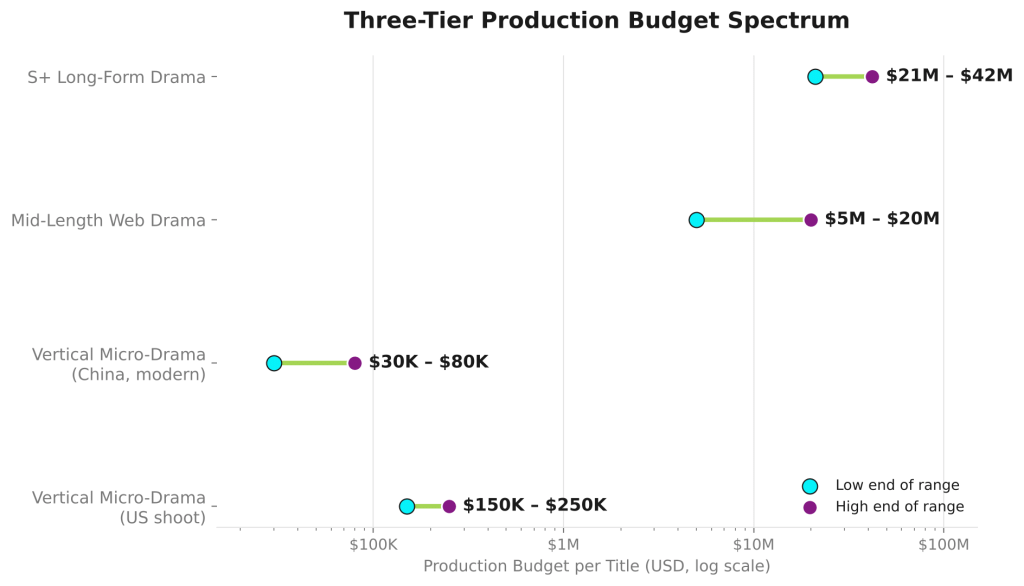
S+ Tier Long-Form Drama (长剧): 36-40 episodes (RMB 150M-300M+ / $21M-$42M+ budget). Monetized via SVOD subscriptions and brand advertising on a 12-24 month production cycle.
Mid-Length Web Drama (短剧): 12-24 episodes (RMB 5M-20M / $0.7M-$2.8M budget). Monetized via split-account revenue sharing (Fenzhang) on a 3-6 month production cycle.
Vertical Micro-Drama (微短剧): 60-100 episodes (typically 80-100; $30K-$80K for modern-setting productions in China, $150K-$250K for US shoots). Monetized via pay-per-episode coin unlocks, weekly subscriptions, and, increasingly, advertising on a 1–2 week production cycle.
Budget reconciliation note: Chapter 1’s dual-engine baseline cites a wider long-form band of $10M-$45M spanning the full flagship slate; the matrix above scopes the S+ tier specifically. Chapter 1’s domestic micro-drama band ($20K-$150K, with period costume pieces up to $400K) covers premium live-action verticals; the figures here describe the volume core of the market, to which AI alternatives (below $30K, or roughly RMB 200K, per title as of 2026) are now exerting deflationary pressure.
Format Benchmark Comparison Table
| Operational / Financial Dimension | S+ Long-Form Drama (长剧) | Mid-Length Web Drama (短剧) | Vertical Micro-Drama (微短剧) |
| Episode Length & Count | 36-40 episodes (45 min/ep) | 12-24 episodes (15–30 min/ep, typically ~20 min) | 60-100 episodes (1–2 min/ep) |
| Average Production Budget | RMB 150M-300M+ ($21M-$42M+) | RMB 5M–20M ($0.7M–$2.8M) | $30K–$80K (China) / $150K–250K (US shoot) |
| Production Development Cycle | 12-24 months | 3-6 months | 7-14 filming days; 2-4 weeks total |
| Primary Monetization Engine | Tiered SVOD, TVOD Express Pass, brand advertising | Revenue-share (Fenzhang), VIP unlock | Pay-per-episode IAP coins, weekly VIP subscriptions, emerging programmatic ads |
| Primary Distribution Channels | iQIYI, Tencent Video, Youku, Mango TV | Platform micro-tabs (iQIYI, Youku) | Standalone D2C apps (ReelShort, DramaBox, NetShort), TikTok/Douyin |
| User Acquisition Strategy | Brand marketing, star fandom, social heat | Organic platform recommendation | Performance marketing (Meta/TikTok paid ads; 55%-75% of revenue) |
| Free-to-Paid Conversion Rate | 3%-5% SVOD conversion | 5%-8% VIP conversion | 10%-12%+ paywall unlock conversion |
| Average Revenue Per User (ARPU) | $12-$35/year (domestic SVOD) | $15-$40/year | $30-$50 per completed series unlock |
3.1 Long-Form C-Drama Platform Economics
Long-form C-dramas remain the flagship asset for domestic streaming giants (iQIYI, Tencent Video, Youku, and Mango TV). Platform economics, however, have shifted from unconstrained content land-grabs toward operating discipline, margin expansion, and non-subscription monetization – a discipline that held through 2025 and is now being tested by free vertical content.
1. Content Spend Discipline & Operating Margins
Following regulatory tightening and capital rationalization, domestic streaming platforms capped content spend ratios at 50%-58% of total revenue. That is a significant drop compared to over 80% during the 2018-2021 platform wars.
iQIYI (NASDAQ: IQ): achieved steady Non-GAAP operating profitability by capping content costs and prioritizing high-efficiency proprietary titles (Zizhijun).
Mango TV (SZSE: 300413): maintains the industry’s highest net profit margins (14%-16%), driven by more than 50 internal production studios that reduce reliance on third-party licensing fees.
2. Monetization Innovation: Express Pass & Content-to-Commerce
To increase Average Revenue per Membership (ARM) without alienating baseline SVOD subscribers, platforms deploy targeted micro-transaction mechanics:
Express Pass / Fast Pass (超前点播 / 加更礼): viewers pay an additional RMB 3 per episode (≈$0.40–0.45), or a package fee of RMB 18–50 ($2.50–7.00) for the final 6–8 episodes of a hit series, ahead of the standard schedule.
Content-to-Commerce Integration: Mango TV’s Xiaomang E-Commerce (小芒电商) embeds real-time purchasing links into video streams, letting viewers buy costumes, accessories, and cosmetics worn by actors on screen.
3.2 Vertical Micro-Drama App Economics
Vertical micro-dramas represent a fundamental departure from television economics. Operating on standalone mobile applications, they rely on cliffhanger mechanics, high-frequency episode release, and algorithmic performance marketing.
1. Monetization Models: Coin-Unlocks, VIP Subscriptions, and the Emerging Ad Lane
Pay-Per-Episode Coin Unlocks (IAP): viewers receive the first 5-10 episodes free; unlocking subsequent episodes requires in-app currency. A complete 80-episode series typically costs $30-50, which is significantly higher per-user spend than a flat monthly SVOD subscription.
Weekly VIP Subscriptions: auto-renewing weekly plans ranging from $5.99/week to $19.99/week ($300-$1,000 annualized), serving high-frequency viewers who binge multiple series per month.
Programmatic Advertising (emerging 2026): in April 2026, DramaBox became the first vertical drama platform to open its inventory to programmatic buying through The Trade Desk. This is a third revenue lane that partially hedges the paywall model against free-tier competition (see below).
2. The UA Treadmill, Quantified: CAC, Churn, and LTV Compression
Unlike long-form platforms, which rent awareness through brand marketing and star fandom, micro-drama apps are performance-marketing engines. Between 55% and 75% of gross revenue is continuously reinvested into paid user acquisition across Meta, TikTok, and Google. The 2026 data makes the compression concrete:
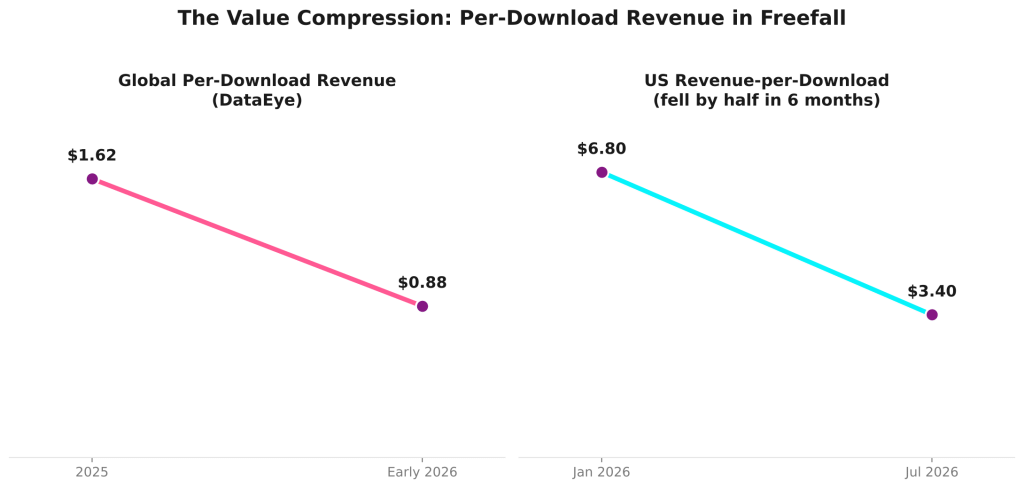
Per-download value collapse: DataEye’s overseas short-drama panel shows per-download revenue falling from $1.62 in 2025 to $0.88 in early 2026; Sensor Tower’s differently-measured panel points the same direction (Q1 downloads +130% YoY, revenue roughly +7%).
US monetization floor: US revenue-per-download fell to $3.40 in July 2026, half its January 2026 level, while the US share of global short-drama IAP slid from 60% (2024) to 49% (Q1 2025) to 37% (Q1 2026). Europe, by contrast, grew 88% YoY. The highest-value market is saturating; growth is shifting to lower-ARPU geographies.
Structural churn: retention drops sharply after a viewer completes a given series, so platforms must perpetually buy replacement users. Analysts tracking ReelShort model its acquisition cost falling only gradually, from 55% of revenue toward ~44% by 2028, a slow curve that current per-download trends suggest may be optimistic.
Author’s observation: Paid acquisition rents an audience; it never owns one. Because micro-drama apps replace churned viewers rather than accumulate them, user acquisition is not a growth investment but a variable cost of revenue, the buyers arrive only while the budget does. The moment spend stops, the revenue stops with it.
The mechanics of this treadmill along with the AI shock that moved the industry’s bottleneck from the set to the feed, are covered in the companion piece “Micro-drama: The Platform Is Not the Product” on The C.Mag; this chapter treats them as settled context and focuses on the numbers.
3.3 The Domestic Engine: China Market Scale & the Regulatory Frame
Global micro-drama economics cannot be read in isolation from the domestic market that supplies its content, talent, and, increasingly, its regulatory constraints.
1. Market Scale
China’s micro-drama sector has grown large enough to rival the country’s theatrical box office: MPA projected domestic micro-drama revenues of ~$9.4B in 2025, on track to exceed the box office for the first time. The overseas segment measured by Sensor Tower reached $2.98B in in-app purchases during 2025 (+115% YoY), with total gross consumer spend across all payment rails projected near $14B globally by end-2026. China supplies the IP library and production infrastructure; the apps monetize it abroad.
2. The Regulatory Frame
Several regulatory layers directly shape the cost curves analyzed in this chapter:
Filing & classification regime: since June 2024, vertical micro-dramas in China operate under the NRTA’s (formerly SART) filing and tiered review system (备案), which classifies titles and routes the largest productions through formal permitting. This ended the sector’s wild-west phase and added compliance cost, while also giving platforms a quality signal that overseas markets benefit from downstream.
AI content labeling: China’s AI-generated content labeling rules, effective September 2025, require identifiable marking of synthetically generated video. For a pipeline in which roughly 95% of new domestic micro-dramas were AI-generated by Q1 2026, labeling is a standing production cost and a consumer-trust variable that platforms ignore at their peril. Only about one in a hundred new AI dramas reportedly recouped its costs in that period, even before compliance costs are counted.
Live-action counterweight: in April 2026, the NRTA launched a support program under which six major platforms, Douyin and its Hongguo app among them, committed no less than RMB 6B to live-action production in May. The state is, in effect, underwriting the premium human tier of the market that AI deflation hollowed out. (The labor and production-side consequences are analyzed in detail in the companion article cited above.)
3.4 The Convergence Trend: Platforms, Attention, AI, and Outside Capital
The boundary between long-form streaming and micro-dramas is dissolving and 2026 gave us the metrics to prove it is now an attention market, not a format market.
1. Attention Metrics: Micro Has Already Won the Clock
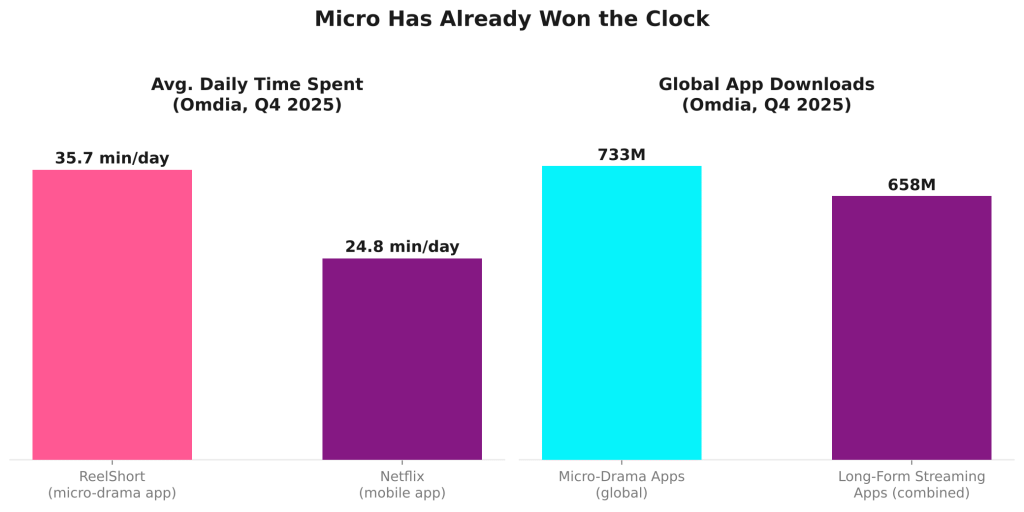
Omdia’s Q4 2025 data puts average time spent in ReelShort at 35.7 minutes per day, ahead of Netflix’s mobile app at 24.8 minutes. In the same quarter, global micro-drama app downloads reached 733M versus 658M for all long-form streaming apps combined. The long-form incumbents are no longer merely competing with each other; they are competing with a format whose episodes fit inside a scroll.
2. Long-Form Platforms Entering Micro-Dramas
Platform micro-tabs: iQIYI, Tencent Video, Youku, and Mango TV have all introduced dedicated vertical short-drama tabs within their primary mobile applications.
Hybrid monetization: platforms offer vertical micro-dramas to existing SVOD subscribers as value-add content while testing standalone pay-per-view options for non-subscribers.
3. Outside Capital Validates the Format
Legacy media has stopped observing and started buying in: Fox Entertainment took a $50M+ equity stake in MyDrama (October 2025), participated in a further $22M round (January 2026), and signed Dhar Mann Studios to produce 40 exclusive vertical titles. When a legacy studio spends eight figures on a two-year-old format, the strategic question shifts from “will vertical drama survive?” to “who owns its economics?”
4. The AI Production Revolution
Generative AI tools are reshaping the micro-drama pipeline across pre-production, visual synthesis, and post-production localization:
| Production Phase | Traditional Live-Action Workflow | AI-Integrated Workflow | Cost & Speed Efficiency Impact |
| Script Adaptation | Human screenwriters (2-4 weeks) | LLM script parsing & hook generation | Time reduced to 1-2 days |
| Visual Production | Live-action crew & set (~$150K-$250K) | AI-simulated avatars / digital humans | Production cost drops below $30K per title |
| Localization & Dubbing | Voice actors & manual dubbing ($10K-$20K) | AI voice cloning & lip-sync alignment | Dubbing cost drops by 80%–90% |
Note the regulatory overlay from 3.3:
In China, AI-generated output now carries labeling obligations effective September 2025, a standing cost absent from the table’s efficiency figures.
Labeling is not a China-specific constraint. The EU AI Act’s Article 50 transparency obligations took effect August 2, 2026 (fines up to €15M or 3% of global turnover); California, New York, and Utah operate separate disclosure regimes; and Meta, TikTok, and YouTube now label synthetic content algorithmically regardless of jurisdiction. For micro-drama operators, AI provenance disclosure has become a standing cost of cross-border distribution and a trust signal that partially offsets the “one-in-a-hundred” recoupment problem in AI-saturated feeds.
3.5 Strategic Case Study: The UA Treadmill vs. Localized Profitability
To understand the financial realities of micro-drama platforms, we evaluate two market leaders operating contrasting strategic models: ReelShort (Crazy Maple Studio / COL Group) and DramaBox (StoryMatrix / Dianzhong Technology). Both remain the clearest archetypes of the genre but as of Q3 2026 they are no longer the whole story: NetShort entered the tracked top tier in April 2026, and Q1 2026 saw ReelShort and DramaBox generate nearly identical in-app revenue (~$140M each). The archetypes hold; the duopoly framing is dated.
Executive Case Study: Scale at a Loss vs. Localized Profitability
All figures below carry measure labels per the Methodology section: “gross consumer spend” is an app-intelligence panel estimate before platform fees; “recognized revenue” and profit/loss are corporate-filing figures.
ReelShort (Crazy Maple Studio / COL Group, SZSE: 300364)
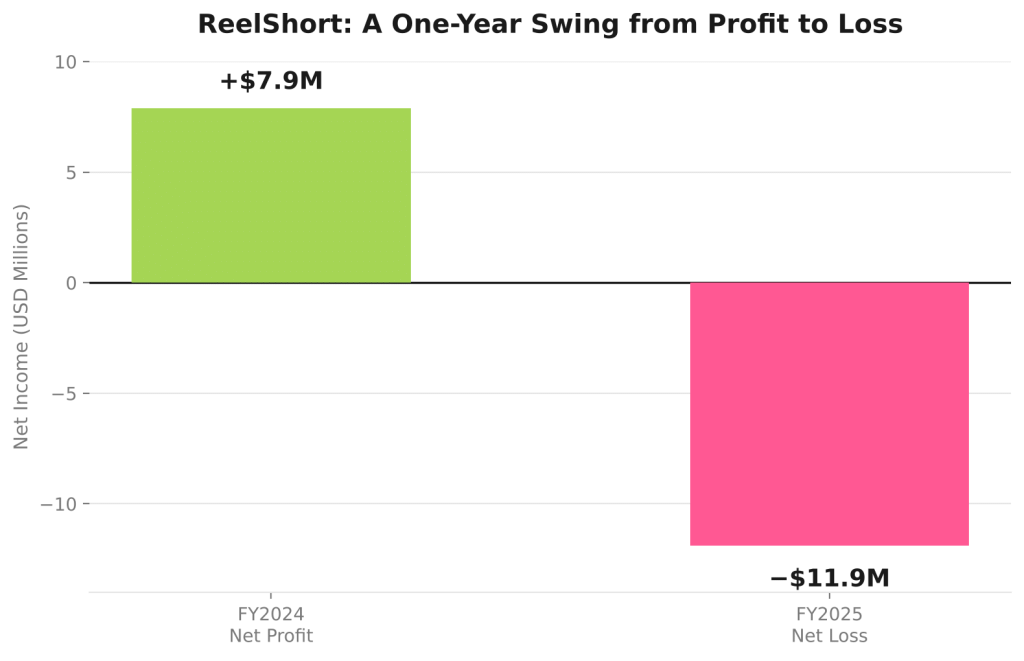
- FY2025 filings (confirmed Q2 2026): recognized revenue CNY 5.72B (~796M); net loss CNY85.8M(~11.9M) in short-drama operations, a one-year swing from a ~CNY 56.7M (~$7.9M) profit in FY2024.
- Validation tier (Appfigures): ~$1.2B gross consumer spend in 2025. The higher figure reflects gross viewer payments before Apple’s/Google’s ~30% platform fee and COL’s own adjustments.
- Trajectory: MAU above 70M as of Q1 2026, up from ~50M in 2025. MPA projects a return to profitability in 2026: ~$1.05B recognized revenue,~$40M net income, as acquisition spend is modeled declining from 55% of revenue toward ~44% by 2028. COL now operates a four-app portfolio (ReelShort, FlareFlow, Sereal+, UniReel); FlareFlow alone is scaling toward 180 US originals in 2026 at $200K-$250K per series.
- Reading: ReelShort’s loss is a spending story, not a demand story. It bought scale at the top of the UA market
DramaBox (StoryMatrix / Dianzhong Technology)
- FY2024 (declared to MPA): revenue $323M with ~$10M net profit, the last audited bottom line publicly available; Dianzhong does not publish ongoing accounts.
- 2025 validation tier (Sensor Tower): ~$530M gross IAP. Note the measurement divergence: Appfigures’ narrower panel counts $276M for the same year. Same company, same period, two panels; the spread is the single best argument for the Methodology’s tier discipline.
- Trajectory: a $100M raise at a $500M valuation (January 2026, per Business Insider); the April 2026 Trade Desk deal, making it the first vertical platform with programmatic ad inventory; US originals slate exceeding 60 titles in 2025; founder-stated ambition of $3B annual revenue within five years.
- Reading: DramaBox monetizes a 2,000+ title translated-Chinese-IP library at subscription-heavy economics, and is now building the advertising lane that hedges the paywall against free-tier competition.
Comparative Performance Matrix
| Operational Dimension | ReelShort (Crazy Maple Studio) | DramaBox (StoryMatrix / Dianzhong Tech) |
| Parent Company / Ticker | COL Group (SZSE: 300364) – four-app portfolio | Dianzhong Technology |
| 2025 Top Line (labeled) | ~$1.2B gross consumer spend (Appfigures)
CNY 5.72B ≈ $796M recognized revenue (filing) |
~$530M gross IAP (Sensor Tower; Appfigures panel: $276M) |
| Primary Monetization Mix | Pay-per-episode IAP coins | Weekly subscription (70%) + IAP coins + emerging programmatic ads |
| Content Library Strategy | High-budget US originals ($150K-$250K/shoot) | High-volume translated Chinese IPs (2,000+ titles) + growing US originals |
| Target Demographic Skew | ~75% female (romance/werewolf) | Balanced (~43.5% male, action/drama) |
| Net Profitability Status | FY2025 loss of CNY 85.8M (FY2024: profit); MPA projects FY2026 return to ~$40M net | FY2024 profit ~$10M; no published 2025 bottom line |
(ShortMax, operated by Jiuzhou Culture / 九州文化, and NetShort round out the tracked top tier as of Q3 2026 and are mapped in Chapter 1’s platform architecture.)
Core Strategic Takeaways
Gross consumer spend in micro-drama apps is a vanity metric if user acquisition ad costs absorb all operating margin. The ReelShort FY2024 – FY2025 swing from +$7.9M to -$11.9M is the cleanest natural experiment in the sector. Long-term sustainability depends on three transitions: from performance-marketing reliance toward proprietary retention (telecom bundling, ecosystem ownership à la Hongguo), from paywall-only economics toward hybrid ad-supported lanes, and from live-action cost structures toward AI-driven production with localization as the remaining moat for non-Chinese players.
Paid acquisition works while LTV exceeds CAC, it is the fastest revenue engine in the sector. But it rents rather than accumulates an audience: micro-drama apps replace churned viewers instead of keeping them, so UA spend behaves as a variable cost of revenue, not an investment. The moment the budget runs dry, the buyers stop arriving and with per-download value halving within a year, the rent is rising on every market that matters.
Two 2026 developments pressure this roadmap. First, the free tier went from threat to structure: ByteDance’s PineDrama (explicitly a loss-leader for the US and Brazil), Melolo, and MiniShorts normalize zero-price vertical content, while JioHotstar’s free micro-dramas during IPL 2026 put AVOD economics directly against the $5.99-$19.99 weekly subscription. Second, the supply side is consolidating: trackers counted 1,549 overseas short-drama apps in July 2026, with the top three holding 52% of tracked TOP20 revenue and analysts projecting survival for only 5-8 platforms. The UA treadmill, in other words, is about to start killing apps, not just margins. In a market where per-download value halves within a year, owning the route to the audience, not the content, remains the only durable asset. (For the full distribution-ownership argument, see the companion piece “Micro-drama: The Platform Is Not the Product.”)
One development points the other way. The same vertical grammar that commoditized in the app economy has proven brand-safe in the hands of luxury and consumer marketers: Loewe’s Qixi micro-drama drew 62 million Weibo views, Marc Jacobs’ ongoing microdrama series outperformed its average post’s media impact value by 52%, and P&G built a 50-episode microsoap for Native, Cannes Lions 2026 gave the format an official track. The economics invert the app model: the brand pays production as marketing, distribution is free, and the viewer never unlocks anything. When content can no longer charge the viewer, the format sells its attention mechanics to brands and that is one of the clean exits from the cheap tier but it runs on celebrity and craft, not coins.
Chapter 3 Methodology & Verified Literature Sources
Data currency statement. All figures reflect the most recent complete reporting period available at publication (October 2026): corporate filings for FY2025 (confirmed through Q2 2026), app-intelligence panels for Q1–Q3 2026. Where the market moved after a data cutoff, the cutoff is noted in-line.
Measurement caveat: read before citing any number in this chapter. This sector is measured by instruments that disagree with each other by design.
The chapter applies the same triangulated hierarchy established in Chapter 1:
| Data Tier | Sources | Role in this chapter |
| Core Financial Baseline | SEC/HKEX/SZSE filings: COL Group (SZSE: 300364), iQIYI (NASDAQ: IQ), Mango Hypermedia (SZSE: 300413) | Recognized revenue, profit/loss – the authoritative measure |
| Global Market Validation | Sensor Tower, Appfigures, Omdia, MPA, DataEye | Gross consumer spend, IAP, downloads – directional and comparative |
Gross consumer spend (what viewers pay, before Apple’s/Google’s ~30% platform fee and company adjustments) systematically exceeds recognized revenue. Sensor Tower, Appfigures, and DataEye also run different panels: web-store coin purchases, which apps route users toward precisely to avoid the 30% fee, are invisible to some trackers and partially visible to others. The DramaBox 2025 spread (~$530M Sensor Tower vs. $276M App figures) and the ReelShort spread (~$1.2B App figures gross vs. CNY 5.72B/~$796M recognized revenue) are not errors; they are the same reality at different altitudes. All chapter figures are labeled accordingly, and YoY comparisons are only drawn within a single measure.
Reference Links & Core Literature
Specific sources (cited in-line)
- MPA ReelShort profitability projection (Variety, 2026)
- DataEye H1 2026 Overseas Short Drama & AI Drama Report (via 36Kr, Aug 2026)
- DataEye H1 2026 Domestic Live-Action Micro-Drama Report (Aug 2026; Hongguo 357M MAU)
- NRTA Order No. 16 analysis, Measures for the Administration of Micro-Dramas (TopDrama.app, 2026)
- NRTA State Council press conference, 18 September 2026 (430,000 releases, 68,000 takedowns)
- China Literature 2026 Interim Results (PR Newswire, 11 Aug 2026; Qidian Theater / ToonScroll)
- Streaming Lens, Micro-Drama Production Costs Analysis (2026)
- MinionArts, AI Microdrama Unit Economics (2026)
Publisher portals (panel provenance)
- Media Partners Asia
- Sensor Tower Mobile Insights
- Omdia Media & Entertainment Research
- Appfigures app-intelligence
- COL Group / Crazy Maple Studio Investor Relations (SZSE: 300364)
- PowerDrill / Sensor Tower IQ, The Global Short-Drama Economy 2026