
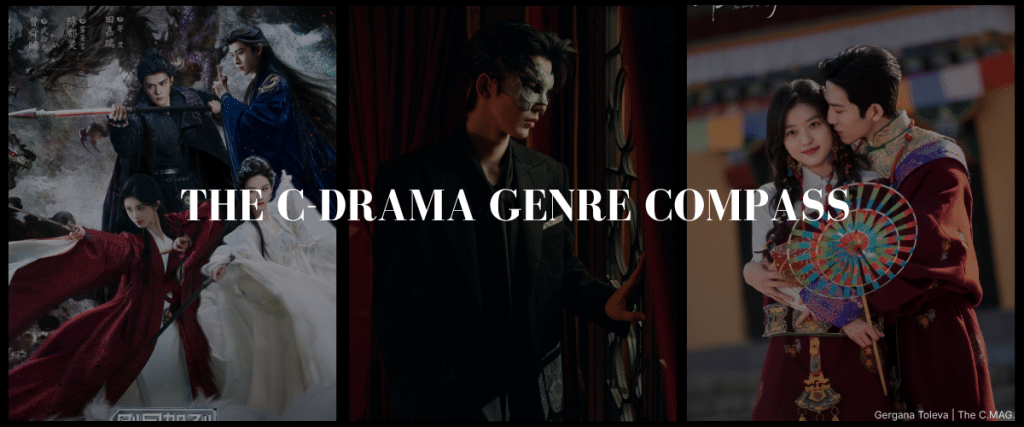
🎬 C-Drama Genres & Industry Architecture: Fast Facts
- Core Categorization: Media assets are systematically grouped across three distinctive historical eras—Ancient Costume, Republican-Era Noir, and Modern/Contemporary.
- The Fantasy Axis: High-concept ancient settings are structurally divided into Wuxia (mortal heroes), Xianxia (Daoist immortals), and Xuanhuan (secondary mythic worlds).
- Upstream Pipeline: Over 50% of the top ten long-form streaming blockbusters natively trace their narrative and audience retention origins to serialized web novel charts.
- Ecosystem Volume: Market operations are divided between traditional long-form series (capped around 30–40 episodes) and hyper-compressed vertical micro-dramas generating over ¥100 billion.
- Regulatory Control: Production spends and genre viabilities are strictly dictated by the NRTA through cast salary guardrails, content approval matrices, and structural broadcast caps.
💬 Chinese Drama Genres Explained: Quick Answers
What is the most popular c-drama genre?
Costume fantasy and historical epics dominate big-budget domestic production, while romance-forward series lead global streaming charts. Cultivation fantasies like xianxia and modern idol romances travel most efficiently across international networks, commanding the largest global fan spaces, subtitle localization projects, and day-and-date D2C platform distribution.
What is the difference between wuxia and xianxia?
Wuxia features ordinary mortal humans utilizing earned martial arts skill, while xianxia introduces Daoist mythologies, celestial realms, and gods. Wuxia operates as “low fantasy” bound by honor codes, chivalry, and internal energy within a historical martial world (jianghu). Conversely, xianxia operates as cosmic “high fantasy” centered on cultivation toward immortality, heavenly tribulations, and epic romances spanning multiple lifetimes.
Why are cdramas so long?
Historical marketplace economics incentivized production houses to shoot 60–90 episode runs because platforms paid per-episode acquisition fees. To counter runaway narrative padding, the NRTA instituted a strict 40-episode cap in 2020, bringing the modern norm closer to 24–40 episodes. While regulatory updates in late 2025 loosened these boundaries for exceptional epics via special review, the structural preference remains focused on leaner, tighter storytelling.
Are cdramas censored?
Yes, every Chinese television and streaming production must secure formal content and distribution licenses from the NRTA before broadcast. This structural review mechanism heavily controls thematic viability, causing whole genres to shift overnight; previous regulatory campaigns have restricted time-travel narratives on broadcast networks, compressed costume fantasy quotas, and banned the dangai (adapted male-male romance) subgenre entirely.
What’s the difference between a cdrama and a K-drama?
C-dramas feature longer, single-season narrative architectures heavily adapted from pre-tested web novels, operating within highly specialized subgenres. While Korean dramas typically average 12–16 episodes and lean toward contemporary thrillers or procedurals, the Chinese ecosystem scales up to 40 episodes, utilizes intensive historical studio hubs like Hengdian, and offers vast blocks of episodes entirely free on international platforms like YouTube.
Where should a total beginner start?
Beginners should select an entry point based strictly on their existing Western or international genre preferences. For sweeping fantasy romance, start with Love Between Fairy and Devil; for grounded political strategy, choose Nirvana in Fire; for premium limited-series crime thrillers, watch The Bad Kids; and for a comforting, modern slice-of-life romance, start with Hidden Love.
💬 The Deep Dive Article
Prepare for a long read on this one, if you are here you’ve fallen down the c-drama rabbit hole. Maybe a friend made you watch The Untamed, maybe Netflix’s algorithm served you The First Frost, or maybe a 60-second vertical drama clip on TikTok did it. Now you’re feeling like the hitchhiker in Douglas Adams’ Hitchhiker’s Guide to the Galaxy and are wondering exactly where you will land if you pick one and start watching. Well, if you pick with xianxia or wuxia but you prefer modern romance it would probably be your one and only touch to it.
So what do they all mean, and where should you start?
This guide is your map. Below, we’ll explain every major c-drama genre, so you can enter this universe prepared. You will know what defines it, what to watch first, and how the pieces fit together? Along with that I’ll show you some pointers for the industry behind them: the streaming platforms, the web-novel pipeline, and the regulators who quietly decide what gets made. Chinese drama genres can look chaotic from the outside, but there’s actually a simple organizing logic, and once you see it, you’ll be able to predict what you’ll love.
In this guide:
- What Is a C-Drama, Exactly?
- How the Industry Works (And Why It Shapes What You Watch)
- The Era Framework: Costume, Republican, Modern
- The Fantasy Trio: Wuxia vs. Xianxia vs. Xuanhuan
- Palace Intrigue and Political Dramas
- Chinese Suspense and Crime Dramas
- Modern Genres: Idol Romance, Urban, Youth, Workplace
- Rebirth, Time Travel, and Other Trope-Genres
- Republican-Era Dramas: China’s Noir Period
- Dangai: The Genre That Was Banned
- Micro-Dramas: The Vertical Boom
- Where to Watch C-Dramas
- Which Genre Should You Start With?
What Is a C-Drama, Exactly?
“C-drama” (oftentimes referred to as “cdrama”) is the international fandom’s shorthand and lately the widespread dominating term across all international audiences for Chinese television and streaming dramas. Those are scripted series produced in mainland China from particular sources and within specific genres and tropes. For clarification, there are also Taiwanese and Hong Kong dramas that have their own ecosystems and fan tags.
Three formats matter for understanding the landscape:
| Format | Typical length | Where it lives | What it’s like |
|---|---|---|---|
| Long-form series | 24-45 episodes × 45 min | Tencent Video, iQIYI, Youku, Mango TV | The mainstream: everything from Nirvana in Fire to Hidden Love |
| Mini/short-run series | 12-16 episodes × 45–70 min | iQIYI’s Mist Theater, Youku’s Bai Ye Theatre | Prestige and suspense — China’s answer to HBO-style limited series |
| Micro-drama (duanju) | 60–100 episodes × 1–3 min, vertical | Dedicated apps, Douyin, Hongguo | Hyper-compressed tropes; a ¥100 billion (~$15B) industry of its own |
Episode counts used to run far higher than it is today with 60, 70, even 90 episodes wasn’t unusual for costume dramas. Then China’s National Radio and Television Administration (NRTA) capped the series at 40 episodes in 2020, with a stated preference for around 30. The average registered drama dropped from 39.8 episodes in 2017 to 28.8 by 2024 (Sixth Tone: https://www.sixthtone.com/news/1017505). In August 2025, the regulator loosened the cap again, with 40 remaining the benchmark and longer series possible via review, so expect some longer epics to return.
While I do understand the need to change the regulation back then, one of the biggest reasons in favor of C-drama is actually the big episode count and the lack of sequels that feel forced. For me this is a leftover sour feeling from the highly exploited commercial approach in Western serialized productions, where spin offs can continue for ages. Of course this is not a one side matter and we need to carefully place verdicts when it comes to production decisions and a good quality, well-reasoned sequel would be appreciated.
How the Industry Works (And Why It Shapes What You Watch)
You don’t need to know industry mechanics to enjoy a drama, but a five-minute primer explains almost everything confusing about the c-drama world, from why shows vanish mid-hype to why certain genres come in waves.
The Big Four platforms run everything
Unlike the US, where production studios decide on what they film then distribute to different networks to buy them, Chinese streaming platforms operate on a completely different process. There is no educated quess when choosing what goes to production just pure metrics taken from a carefully crafted environment for the purpose. The markets’ platforms operate as the commissioners, producers, and distributors in one. We may say that four dominate long-form drama:
- Tencent Video (plus its international app WeTV) backed by Tencent’s gaming and web-novel empire; strongest in big-budget costume fantasy and esports dramas. Roughly 365 million monthly active users as of late 2025.
- iQIYI is the most “prestige“-minded of the four; pioneered the short-form suspense theater concept. ~358 million MAU (Marketing to China: https://marketingtochina.com/how-use-youku-chinese-youtube/).
- Youku (Alibaba-owned) is the home of The First Frost and The Long Season; currently fourth in domestic users but aggressive internationally.
- Mango TV is the streaming arm of Hunan TV; skews toward variety shows and younger female audiences.
Because a drama commissioned by iQIYI appears on iQIYI and its licensing partners (like Viki) but not on Youku or WeTV, fans literally identify shows by their platform. The statement “that’s a Tencent xianxia” is a meaningful sentence. To be completely objective here we need to note that there are productions that are streamed jointly like the recent republican era drama “Overdo”, starring Zhang Linghe and Wang Churan.
Web novels are the script farm
Most famous c-dramas began as serialized web fiction which is previously carefully measured for success. Platforms like Jinjiang Literature City (female-oriented, romance, fantasy, danmei) and Qidian (male-oriented) host millions of serialized novels where readers pay per chapter; the most popular get bought for adaptation. Tencent consolidated much of this ecosystem under China Literature (Yuewen), and the pipeline is astonishingly productive: six of the top ten long-form dramas by cumulative views in the first half of 2025 were adapted from China Literature IPs (China Literature interim results: Read Article Here.
This is why c-drama genres map so neatly onto web-novel categories. The audience and the source material literally arrive together. It’s also why domestic acceptance is very different from international acceptance on most of the c-dramas. There is always a debate on the quality of the adaptations: what the novel survavises on narrative is oftentimes filtered through the regulations of NRTA to be shown on screen for wider audience.
Regulation is the invisible showrunner
China’s NRTA approves every drama before broadcast, and its rulings have repeatedly reshaped the genre landscape. There are clear consequences that with the industry’s carefully measured environment are easily caught. Examples for such shifts induced by regulatory decisions are the quotas for costume-drama downsizing which reduced the fantasy supply in 2019; the 2020 episode cap that shortened everything; the 2021 entertainment-industry crackdown banned the entire dangai genre (more below). In August 2025, the pendulum swung the other way with looser episode limits, seasonal series no longer forced to wait a year between parts, faster review process with the single aim to stimulate content supply (Sixth Tone Artcle Here).
Practical takeaway for viewers: genre trends in China are partly a consequence of regulatory actions on domestic market.
It is important to acknowledge though is that the decisions are usually taken under particular metrics taken into account. Eventough, sometimes those might not seem valuable for a genre or the c-drama fans, when metrics show reason those directions change as we clearly saw above with changes from August 2025. Additionally, domestic market evolves and adapts to those changes and sometimes you would find new genres or forms of distribution find their way around regulations.
“For a closer look at how NRTA vetting shapes performances and why platforms are pulling exclusives onto their own apps, see “Long-form C-Drama: the Pull behind the Scenes“
The Era Framework: Costume, Republican, Modern
Before we go into the genres classification, one question sorts the entire c-drama library: when is it set? They are naturally organized by era first, and you’ll see these categories on every platform menu:
- Costume/ancient dramas (古装, guzhuang) – imperial China or mythic antiquity. The largest and most export-friendly category, containing all the fantasy genres plus palace intrigue and historical romance. Many are filmed at Hengdian World Studios in Zhejiang, which handles nearly two-thirds of China’s costume drama production. It is one of the reasons so many dramas share the same palaces (Hengdian World Studios) and at the same it is important for budget distribution of the production. Once the setting is not the major investment for a series it could be spent elsewhere and contribute to the quality of actors’ cast, costumes etc.
- Republican-era dramas (民国剧) – 1912–1949: warlords, foreign concessions, qipaos, jazz clubs, espionage. Think of it as China’s noir era.
- Modern dramas (现代剧) – contemporary settings: idol romance, urban women’s dramas, workplace series, campus stories, and most crime/suspense.
A useful mental model: era tells you the costume; genre tells you the engine. Story of Yanxi Palace and Love Between Fairy and Devil are both costume dramas, but one runs on harem scheming and the other on celestial romance.
The Fantasy Trio: Wuxia vs. Xianxia vs. Xuanhuan
For me coming to this one from the West but having the background of knowing Asia through work, this category is one of the most fascinating ones. At the same time this is the most-difficult to explain as there are oftentimes no terms in English to describe the genre, the characters and the interactions between them in the plots. It is also one of the genres that needs deep understanding on the plot dynamics and tracking multiple lines of actions. It is a question that is asked very often and misunderstood by newcomers in the c-drama world. The answer is simpler than it looks though.
Wuxia (武侠, “martial heroes”) is the oldest and most grounded genre of those three. Heroes are ordinary humans who achieve extraordinary skill through martial training and internal-energy cultivation. That happens by moving through the jianghu (the martial world of sects, alliances, and wandering swordsmen) bound by codes of honor and chivalry. Think about is as “low fantasy”: no gods, no immortality, just earned skill and moral conflict. Jin Yong’s novels (Legend of the Condor Heroes and many more) are the genre’s foundation; recent standouts include A Journey to Love and The Blood of Youth.
Xianxia (仙侠, “immortal heroes”) adds Daoist cosmology. Characters cultivate toward immortality through qi refinement and realm breakthroughs, in worlds populated by gods, demons, and reincarnation cycles. Think “high fantasy” where the main antagonist may literally be Heaven itself. On screen, xianxia is overwhelmingly romance-first, usually structured around love spanning multiple lifetimes: Eternal Love, Ashes of Love, Till the End of the Moon and, for the strongest single entry point of the last few years, Love Between Fairy and Devil (2022), which recalibrated the genre around a vulnerable demon-lord lead and genuinely cinematic production values (Tatler Asia Article).
Xuanhuan (玄幻, “mysterious fantasy”) is the free-for-all: invented secondary worlds with original power systems, unbound by Daoist cosmology it sometimes remixes game-like or even Western fantasy elements. The quick test: if it has cultivation but no Daoist scaffolding (no immortals, no heavenly tribulations), it’s probably xuanhuan. Battle Through the Heavens is the archetypal example, while a recent on-screen case is Guo Jingming’s Veil of Shadows (2026) — a demon-and-deity fantasy whose power system answers to no scripture (Wuxia Society Article).
| Wuxia | Xianxia | Xuanhuan | |
|---|---|---|---|
| World | Historical jianghu | Celestial realms & mythic China | Invented secondary worlds |
| Power source | Martial skill + inner energy | Cultivation toward immortality | Custom power systems |
| Fantasy level | Low | High | High, rules vary |
| Classic tone | Honor, brotherhood, tragedy | Epic multi-lifetime romance | Adventure, power progression |
| Start with | A Journey to Love | Love Between Fairy and Devil | Battle Through the Heavens |
One honest caveat: the borders are fuzzy and getting fuzzier. The Untamed borrows from both wuxia and xianxia; recent hits gleefully mix everything. Use the labels as a compass, not a fence.
The first one I experienced was Love Between Fairy and Devil and then came Veil of Shadows and honestly I didn’t even think they were different genres at the time. Just a research away and there you go…You have a three layer classification on which one goes where.
Palace Intrigue and Political Dramas
If fantasy is the glamorous export, court drama is the domestic heavyweight and it is totally worth watching at least one of those to see if they will be your plate.
Palace intrigue (宫斗, gongdou) is the harem-scheming genre: imperial consorts competing for the emperor’s favor through alliances, poison, and rank advancement, where survival itself is victory. The modern canon runs War and Beauty (2004) → Empresses in the Palace (2011) — still the genre’s gold standard — → Story of Yanxi Palace (2018), whose revenge-driven heroine helped it rack up 530 million views in a single day and over 15 billion streams on iQIYI in 2018, according to platform figures (Wikipedia Article).
Historical political drama (权谋, “power-scheming”) is the court-side counterpart: strategists, succession struggles, statecraft, and long-game revenge. Nirvana in Fire (2015) is the unchallenged benchmark where a wronged strategist is patiently engineering justice across 50-plus episodes, praised for its historical texture and reaching 13 billion views by end-2016 per platform reporting (Wikipedia Article).
Two things to know as a viewer. First, these genres were specifically targeted by the 2019 costume-drama restrictions, which is why supply dried up for a while. Their current comeback is part of the post-2025 loosening. Second, the commercial sweet spot right now is fusion: political intrigue blended with strong romance lines. Pursuit of Jade (2025) runs court power struggles and a marriage-of-convenience romance in parallel and rode that mix to Netflix’s global non-English chart, while Blossoms of Power (2026) wraps the classic scheming-court template around a massacred princess reinventing herself as a cold strategist opposite a frail-seeming, razor-minded Crown Prince, where their mutual exploitation slowly becoming genuine alliance.
From my own experience: if you enjoy serious intrigue and Agata Kristie style plots Pursuit of Jade won’t be your choice to watch but the beauty of it all is that there is something for everyone and Blossoms of Power is a good starting point for court intrigue.
The true beauty of Pursuit of Jade comes from a completely different set of qualities of the production and romance and amazing visual art and lead chemistry is what is a huge yes for me personally.
Chinese Suspense and Crime Dramas
China’s answer to prestige TV is organized around branded platform “theaters” curated genre blocks that work like imprints. iQIYI’s Mist Theater (迷雾剧场), launched in 2020, institutionalized the short-run suspense drama: 12-16 episodes, cinematic production, single tight case. Youku’s Bai Ye Theatre is named after the genre’s modern breakthrough, Day and Night (2017), the twin-brothers thriller later acquired by Netflix (ChineseIdioms Article).
The canon is unusually strong:
- Day and Night (2017) – a detective and his fugitive twin sharing one identity; Douban 9.0.
- The Bad Kids (2020) – three children film a murder; the show that made Mist Theater famous.
- The Long Night (2020) – a prosecutor’s decade-long fight against a buried case; Douban 9.2.
- The Long Season (2023) – a slow-burn rust-belt mystery; Douban 9.4, the highest-rated Chinese crime drama ever.
Expect differences from Western procedurals: non-linear multi-timeline structures, heavy social realism (the 1990s layoff era recurs constantly), morally ambiguous police, and endings that deliberately refuse tidy closure. If you come from K-drama thrillers or HBO limited series, this is your most natural entry point into c-dramas.
This is one of the genres I still have to experience myself before I am able to get the real experience in writing but it is way too prominent to leave it out of the equation.
Modern Genres: Idol Romance, Urban, Youth, Workplace
Modern idol romance (偶像言情) is the international volume leader, besides the breakthrough of Pursuit of Jade from the historical c-dramas genre. It is the genre behind most Netflix Top 10 entries. “Idol drama” is a real industry label in China, distinguishing star-driven, romance-first productions from “serious” dramas, and the global numbers justify the strategy: The First Frost (2025) hit Netflix’s global Top 10 and passed 1.5 billion views on Youku. Signature flavors: cold-CEO archetypes, healing romance, second chances, childhood-friends-to-lovers. Start with Hidden Love, which is the warmest gateway drug in the genre, then continue to its follow-up The First Frost (same universe, watch in that order). Two more recent standouts worth your list: The Best Thing (2025), a gentle healing romance built around a traditional-medicine doctor, and Shine on Me, which pairs campus origins with grown-up stakes.
Urban and workplace dramas use real industries as both setting and stakes like medicine, law, media, advertising. The Early Spring (2026) is the current benchmark: a rookie copywriter and a razor-tongued creative director in a top Beijing ad agency, equal parts office politics and push-pull romance; it reached No. 2 on Netflix’s global non-English TV chart in its first week. The adjacent urban women’s ensemble (“she-era”) cluster comes with Ode to Joy, Nothing But Thirty. It follows groups of professional women navigating career, marriage, and friendship, and drives national conversation domestically.
Youth and coming-of-age dramas are the gentler corner of the modern shelf. Our Generation (2025) is a textbook example – a nostalgic, slow-burn story of childhood friends growing up through the 1990s and 2000s, while Love for You (2026) shows the trope’s darker edge: two teenagers bound by their parents’ relationship, torn apart by an arson case, and reunited years later as adults with unfinished business. And the distinctly Chinese esports subgenre (Go Go Squid!, The King’s Avatar) grows directly out of Tencent’s gaming empire.
For me the modern romance genre is the unique way to experiencing modern Chinese society dynamics in all its layers, beauty and pain points.
If The Best Thing showed me how Chinese Medicine treats patients and that there is an actual clash with Western medicine in the medical societies in the country, then Our Generation gave me the harsh reality of the younger generations with their caste division, bullying and the difficult hidden emotional conflict of today’s youth society.
Rebirth, Time Travel, and Other Trope-Genres
A quirk of the c-drama landscape: trope clusters behave like genres. Fans don’t just ask “what should I watch” but rather “what are the best rebirth dramas.”
Rebirth/revenge (重生) is the current champion: a wronged heroine dies betrayed and wakes up years earlier, armed with foreknowledge, to outmaneuver everyone who destroyed her. Story of Kunning Palace (2023) is the accessible modern standard-bearer of this genre, where an empress is reborn into her own past, determined to avoid the throne this time, with a quietly terrifying mentor figure at the center. Blossom (2024) on the other side delivers the genre’s other signature pleasure: a shrewd heroine rebuilding her family’s fortunes and out-scheming a household full of enemies. The Double and The Princess Royal round out the starter pack.
Time travel (穿越) is the older sibling with Scarlet Heart (2011) defining the template of a modern woman stranded in the Qing dynasty. As I mentioned earlier when we discussed the changes of regulations, here we should note that even though time-travel was restricted on broadcast TV for years, this rule pushed the trope into web dramas and rebirth variants.
Other trope clusters worth knowing: marriage of convenience / contract marriage, enemies-to-lovers, master-disciple romance (a xianxia staple), and amnesia (yes, still alive and well). When browsing MyDramaList or Douban, filtering by these tags is often more useful than filtering by genre.
Republican-Era Dramas: China’s Noir Period
Set roughly between 1912 and 1949, Republican-era dramas (民国剧) function the way noir does for Hollywood: warlords and foreign concessions, qipaos and tailored uniforms, jazz clubs, espionage, and romances conducted under the shadow of national collapse. The aesthetic alone earns the genre a devoted following, but the emotional register is what hooks people as these stories run darker and more tragic than almost anything else in the c-drama catalog.
Two recent entries show the range. Overdo (2026) is the full tragic-romance experience: an abused warlord’s son, a faked death, a return years later as his brother’s fiancée all layered in love and resentment intertwined against national crisis. Winter Begonia (2020) sits at the genre’s other pole: a 1930s Beijing opera actor and a businessman, in a story adapted from a danmei novel and famously reworked into a tribute to friendship and a dying art form. It’s also the rare dangai-adjacent title that aired before the 2021 ban. For the espionage-heavy wing of the era, The Disguiser is the classic pick with more to come by the end of 2026.
Dangai: The Genre That Was Banned
No genre guide is complete without dangai (耽改) or in other words dramas adapted from danmei, the hugely popular male-male romance web novel genre. Because explicit LGBTQ+ romance doesn’t pass broadcast censorship, these adaptations code the central romance as intense “brotherhood” and the subtext became the entire appeal. Guardian (2018), The Untamed (2019), and Word of Honor (2021) built some of the largest international fandoms in c-drama history on exactly this dynamic (SOAS China Institute Blog).
In September 2021, regulators denounced dangai as part of an entertainment-industry rectification, and the format has been effectively banned since with the already completed adaptations remaining shelved indefinitely. The existing titles still stream internationally, which creates the strange situation of a genre that is frozen in time but still actively recruiting new fans. The creative energy has largely migrated to formats with more room: donghua (animation), audio dramas, and the original novels.
Micro-Dramas: The Vertical Boom
The newest category isn’t a genre at all but rather it is a format where the jury is still out to decide in what direction it will go with the industry being heavily affected by its development. Micro-dramas (微短剧, duanju) are vertical, phone-native series with 1–3 minute episodes, cliffhangers every 60 seconds, and tropes (rebirth, revenge, secret billionaires, contract marriage) compressed to maximum velocity. The Chinese market hit ¥50.4 billion in 2024, surpassing the annual film box office and exceeded ¥100 billion (~$15 billion) in 2025, with over 800 million domestic viewers (Read further on vertical dramas in the C.MAG). Overseas apps in the same ecosystem (ReelShort, DramaBox) earned $3.24 billion in 2025, much of it from locally produced remakes of Chinese hit formulas.
Love them or hate them, they’re now the entry point for a huge share of new viewers and traditional platforms are launching their own vertical channels in response. Worth a try with expectations calibrated: think soap-opera concentrate, not S+ budget tier drama.
Where to Watch C-Dramas
Legal options are better than ever, and surprisingly much is free:
- Platform apps: WeTV (Tencent), iQIYI, Youku, and Mango TV all have international apps with free ad-supported tiers and VIP subscriptions that unlock early episodes.
- Rakuten Viki: the long-time licensing home for international fans, with community subtitles in dozens of languages.
- Netflix: selective but growing; increasingly carries first-run hits (The First Frost, Pursuit of Jade).
- YouTube: the hidden gem: many Chinese dramas are officially released free with subtitles on platform channels, a distribution quirk which is quite different from K-dramas (DW Coverage).
For tracking what to watch next, MyDramaList is the community standard with ratings, reviews, and trope tags, with the caveat that its scoring runs generous.
Which Genre Should You Start With?
Here is a c-drama starter pack to get you hooked:
- You want epic fantasy romance – Xianxia: Love Between Fairy and Devil
- You want grounded martial arts and honor codes – Wuxia: A Journey to Love
- You want scheming and slow-burn revenge – Palace intrigue: Blossoms of Power, or political: Nirvana in Fire
- You want a historical epic love story – Pursuit of Jade is your starting point
- You want a tight prestige thriller – Suspense: The Bad Kids or The Long Season
- You want a comforting modern romance – Idol romance: Hidden Love then The First Frost
- You want a young-adult bitter-sweet love story – Our Generation is a must watch
- You want ambition, banter and office stakes – Workplace romance with a bunch of red flags: The Early Spring
- You want cathartic revenge with a rebirth twist – Story of Kunning Palace
- You want beautiful tragedy in tailored suits – Republican-era: Overdo or Winter Begonia
- You want to understand a cultural moment – The Untamed (then read up on dangai)
The Bottom Line
C-drama genres might look confusing at the start and be considered the romanized version of the Chinese terms until you see the structure: era first, engine second. Costume, Republican, or modern tells you the world; wuxia, xianxia, gongdou, suspense, or idol romance tells you the machine driving the story. Behind it all sits an industry where platforms greenlight genres strategically, web novels supply the stories, and regulators set the weather.
For me it is definitely worth the orientation course, as it is a fascinating world that is open to all of us viewers and it is much more different and rewarding to watch than many others if one is open to look between the lines. My advice is: start with one genre that matches what you already love, give it three episodes, and then decide where it takes you. This guide’s genre deep-dives may take it from there as I grow them or not, it all depends on you and what you are looking for in a story.
Author’s Note: There will be upcoming detailed guides to every genre covered here. If you are curious you can bookmark this page as it will stay updated as the industry changes and new articles for each genre come out.