
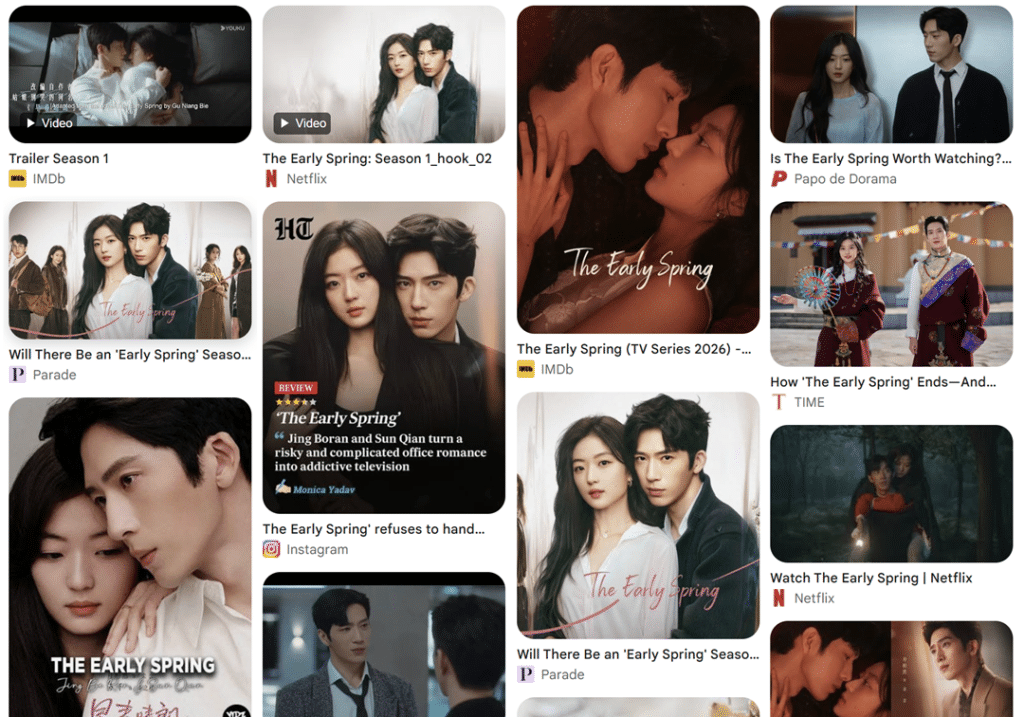
A Grounded Real Life Story Shining Through the Lens of Cinematic Art
Spoiler Notice: Watch first, read after! This article includes spoilers as it discusses in detail the plot, chosen scenes and other specifics of the series.
🎬 “The Early Spring” (早春晴朗) Fast Facts
- Total Episodes: 24 Episodes (Adaptation of web novel Zao Chun Qing Lang)
- Main Cast: Jing Boran (Luan Nian / Luke) & Sun Qian (Shang Zhitao / Flora)
- Director: Jiang Jizheng (Taiwanese director known for controlled soundstage shooting)
- Global Performance: Historic milestone for a modern mainland urban series, debuting at #2 on Netflix’s Global Non-English TV chart and peaking at #4 worldwide across all languages.
- Critical Verdict: 8.5 / 10 (A-Tier). A mature, highly disciplined slice-of-life study balancing raw realism with heavy corporate subtext, slightly held back by a compressed final resolution arc.
💬 The Early Spring (早春晴朗) Quick Answers
Why is the Douban score for The Early Spring lower than its international metrics?
The score discrepancy stems from domestic audience expectations regarding novel fidelity and toxic relationships. Book purists on Douban (6.7 rating) heavily penalized the series for altering Luan Nian’s character traits from Gu Niang Bie Ku’s original web novel Zao Chun Qing Lang and for the unsettling corporate office environment. Conversely, international audiences on platforms like Netflix unburdened by the source text evaluated it as a standalone urban melodrama, praising its raw realism and psychological depth.
Did Jing Boran style his own wardrobe in The Early Spring?
Yes, Jing Boran personally curated his character’s look by bringing over 100 items from his private luxury clothing collection to the set. Bypassing traditional studio wardrobe resources, he utilized his personal archive of high-end tailoring to build a distinct physical map of Luan Nian’s emotional state—using rigid, earth-toned three-piece suits as armor early on, and relaxing into softer silhouettes as his arrogance dissolved.
Does The Early Spring have a happy ending?
Yes, The Early Spring concludes with a happy ending for the main couple, but the final resolution timeline is highly compressed. After spending twenty-one intensive episodes tracking their secret, unequal workplace dynamic in Beijing, the script calls for a massive shift to Harbin for the final three episodes, wrapping up six years of emotional stagnation and personal growth at an accelerated pace.
What is the significance of the intimacy coordinator in The Early Spring?
The series stands out as one of the very first mainland Chinese television productions to officially credit a professional Intimacy Coordinator (Tsai Chia-yin) on set. Due to strict local broadcasting compliance standards regarding explicit visual content, the production utilized this specialized role to channel the intense, borderline-obsessive relationship dynamic entirely into psychological tension, precise physical blocking, eye contact, and the deliberate speed of approach.
📊 Global Ratings & Platform Reception
| Platform / Tracker | Metric Type | Score / Position |
|---|---|---|
| Youku (Domestic) | Popularity Index | Surpassed 10,000 (Record Breakout) |
| Yunhe Data (Domestic) | Broadcast Market Share | 40.3% Share |
| Douban (Domestic) | User Rating | 6.7 / 10 (Highly Polarized) |
| Netflix (Global) | Non-English TV Chart | Debuted at #2 (2.4M views week one) |
| Netflix (Worldwide) | Top TV Shows Chart | Peaked at #4 (All Languages) |
| Global Distribution | Market Reach | Top 10 in 22 Markets |
The Deep Dive Review
Performance Context: Analyzing the Domestic vs. International Metric Split
True to being objective, the first thing we do is look at the C-drama’s performance numbers that “The Early Spring” received with the audiences – domestic and international ones. As expected (at least for me at the G. Blog as the reviewer) the domestic reception and the international one tell quite different stories.
Domestic Reception
On Douban, where we could usually find the most critical viewers and reviews, the drama sits at a rating 6.7/10 with quite strong polarization of opinions. They are split between the trope it explores with the toxic relationship and work environment at the center on one side and then the characters’ adaptation that deviates from the actual book on the other.
To be specific the cited number above is derived from roughly 40,000 ratings with over half of voters awarding three stars or fewer. The negative reviews feel mostly like a primary reaction related to the toxic relationship and the dislike of both characters’ interactions between each other in this relationship rather than an actual in-depth critique of the series’ psychological intention and its quality. As the release aggregates further time from its release, discussions on Douban are shifting to a more mature overview. I can see conversations about the real value of the series with real analysis of both characters and the two sides of the relationship development.
Those reactions are completely understandable if you look at it objectively. Firstly, the trope is not the typical CEO relationship a fan of contemporary drama would expect.
Secondly, there is the director’s choices and the actual intent behind the script when it comes to artistic choices. In my opinion those decisions are far more sophisticated than just the regular CEO trope exploration.
On a third note, we always have to consider the navigation of NRTA regulations and censorship mechanics, so the drama actually airs.
International Reception
Internationally, where the audience is unburdened by source-material and is already used to the trope of toxic CEO relationship narrative for years, it was immediately embraced and the raw realism of the series contributed to this immensely. Its debut as #2 on Netflix’s Global Non-English TV chart with 2.4 million views in its first week is a first for a modern mainland Chinese series. Along with that it reached the Top 10 in 22 markets, and, the milestone that made industry watchers sit up and peaked at #4 on the Top TV Shows Worldwide chart across all languages.
What I know from experience is that US audiences are used to the trope of “CEO toxic relationships turned fairy tale” for years now thanks to the huge number of published romance books on that topic. However, western entertainment doesn’t have the discipline and approach to actually turn those into productions with the visual restraint Chinese entertainment does. Along with that raw realism is something very typical for European cinema, where actors are much more central to the production, instead of special effects and highly visual cinematography.
The one thing that really makes it stand out among other idealized CEO romances is the depth of all the characters in the storyline and the maturity with which the story develops. That is not so visible on the surface as the viewer is prompted to understand this via quiet moments, untold truths, long silence and gaps in the conversation. The viewer needs to be observant enough to actually catch up with it and that is where polarization in accepting the drama comes from, at least from my perspective. If we go beyond the chemistry between the main characters we could see the dynamics of a relationship equally flawed on both sides. At the same time, the raw realities of the other characters are as interesting and important for society as the main leads.
The one thing we need to address in that initial context is how The Early Spring came to impact the C-drama market in 2026 and why this is significant when we review it. Unlike massive S+ historical dramas, this is an A-tier modern urban project that relies on grounded realism and an uncomfortable power dynamic. With its maturity and “straight out of real life” story, it is already different. The end result is a huge commercial success, which reached the metrics of an S+ tier drama on performance but an A-tier budget e.g. exceeds 10,000 on Youku’s Heat Index and debuted at #2 on Netflix.
Socio-Cultural Dynamics: What Western Audiences Must Understand
1. The Novel Baggage
The Early Spring is adapted from the web novel Zao Chun Qing Lang by Gu Niang Bie Ku. The television adaptation softens Luan Nian significantly from his literary counterpart, humanizing him earlier in the story. While this editorial choice makes him more palatable for television, Douban critics actively debated whether this sanitized the darker reality of the original book.
2. The Beipiao (北漂) Reality and 996 Culture
The drama operates as an honest critique of the Beipiao (北漂) or otherwise translated literally as the “Beijing drifter” experience. This is referring to the millions of young ambitious people who come to the “big city” to chase a career in Beijing. The extreme pressure of the 996 (working 9 am to 9 pm, 6 days a week) is the real corporate lifestyle and serves as the primary antagonist. Western viewers must understand that this high-pressure environment is not simply a dramatic backdrop, but a devastating reality that drives the narrative’s central tragedy and influences all characters in the series.
3. Director Specifics & Approach
Jiang Jizheng, a Taiwanese director working across the strait, was not the reason book fans got on board with this casting. A fourteen-second teaser, released before the premiere, did that work by itself, reversing a wave of early skepticism about whether Jing Boran and Sun Qian suited the novel’s central pairing. Jiang’s visible calling card across the production is heavy soundstage shooting, used to keep the Beijing office scenes controlled and the framing consistently cinematic rather than location-dependent. His more telling choice sits at the show’s tragic hinge: the Episode 20 suicide is staged with no on-screen jump. The sequence is built entirely from subtle scenes, and the other characters’ reactions, a restraint that keeps the moment from tipping into spectacle. Jiang’s intimacy sequences, developed with credited intimacy coordinator Tsai Chia-yin, follow the same logic: they are blocked around breath, eye contact, and the speed of approach rather than around explicitness, and the tension holds because of that discipline rather than in spite of it.
Plot Development & Visual Craft Breakdown
Spoiler Alert! The following section contains explicit plot reveals and analyzes the specific cultural controversies surrounding the drama.
Beijing and the Lime Years
Twenty-one episodes belong to Lime, the elite advertising agency where Shang Zhitao, an ordinary graduate and Beipiao, lands her first job and is told by her new boss, Luan Nian, to quit before she has unpacked her desk.
Then there is Lumi, bold, outspoken and a bit rebellious, a prominent character across the whole series. And Sun Yu, the one character that rarely gets to be mentioned online, is the other best friend to Shang Zhitao besides Lumi. She bravely and securely has Tao’s back all the time, while working in her own difficult job then growing her own start up company and even supporting her business when she goes to her own business later on.
Running alongside the central pairing is also Sun Yuanzhu, Zhitao’s roommate, a self-made young scientist from a poor rural background who spends the season quietly absorbing his mother’s medical bills, his father’s gambling debts, and a private, undeclared feeling for Zhitao that he never acts on.
The show plants his character’s collapse in small domestic beats rather than melodrama. Him always smiling, always having that wise mellow attitude that no one sees thru. The celebration of the three of them on Spring Festival, where Sun Yuanzhu gets them gifts and they are each other’s best company for the evening. The warm suggestion to cook dinner for everyone. His false bravado that he will make a difference in his company after trying so much time. It all then comes to the sad resolution of his sudden and faceless quiet demise, which in a way is only loud to the people who surround him. The contrast is very stark and shows what being one of the many means in such a big world.
Zhitao, blindsided by a promotion loss the same day and convinced Luan Nian tanked her review, breaks. She resigns, cuts contact, and leaves Beijing.
Harbin and the Reckoning
The final three episodes relocate to Harbin, where Shang Zhitao rebuilds around a restaurant and a small event business of her own. The production used Central Street and the Saint Sophia Cathedral square as anchor locations, converted a real building on West 13th Street into the fictional Old Couple’s Tavern, and supplemented the winter look with artificial snow to get the specific pale, early-spring light the title promises before the season’s natural snowfall arrived. It is the strongest visual stretch of the show precisely because it trades the agency’s fluorescent geometry for open, weathered exteriors that give the actors room to be still.
This is the moment where we can see clearly the unbalance between the episodes and the arc of the series. We’ve spent 21 episodes in Beijing and more than 6 years, then we get the full resolution of this complicated relationship in the span of 3 episodes.
Now to be completely honest, I somehow agree with the director’s choice on this as oftentimes we end up with an arc of reconciliation that is far more stretched than necessary. However, in order to be objective, I also acknowledge that a bit more depth to that part of the story would be beneficial for the finale. Viewers get their happy ending anyway, while previously the question was not “When will they get together?” but “When will they start talking to each other for real?”.
Sonic Landscape: The Acoustic Contrast of Open-Plan Office Silence
The score is acoustic-led and deliberately restrained, entering to mark emotional turns rather than to underline them. The sound design earns its keep in the contrast it draws between the two settings: the layered, overlapping noise of an open-plan agency floor against the muffled, wind-flattened quiet of a Harbin street in winter. That contrast becomes the show’s clearest sonic idea in its final stretch, where silence does more work than the score itself.
Narrative Analysis: The Red Flag Effect, Fifty Shades Parallel, and Character Stagnation
The interesting thing for the series is that we have a brilliant subversion of a slow-burn C-drama in a very unexpected way. The series offers us two different arcs, one that is the physical fast and secretive “situationship” we get almost right at the start. It skips the hand-holding and the blushing that usually happens for half of the series’ episodes, and goes straight for the “friends with benefits” type of relationship but I would even omit the “friends” part.
And then the ultimate slow burn arc is actually the emotional one that drags throughout the whole series until probably the very end. It takes Luan Nian and Shang Zhitao six years and more than 20 episodes to overcome their own characters. For him is his arrogance as a defence mechanism and for her is the inferiority complex that makes her feel small and undervalued.
The “Red Flag” Effect & The Fifty Shades Parallel
The drama occupies a highly specific viewing niche, and its core mechanics mirror the Fifty Shades of Grey, and many similar to it, as a domain space. A wealthy, emotionally guarded executive initiating a secretive, highly unequal relationship with a naive subordinate is not something that is foreign to viewers worldwide. We’ve seen the hype, the movies and all. However, because Chinese broadcasting standards have very specific requirements on explicit content, the production channels that borderline-obsessive dynamic entirely into psychological tension, sharp dialogue, and the use of an Intimacy Coordinator. That being said, I’ll make a detour and share that having an Intimacy Coordinator is among the first for mainland productions, and it makes a difference.
Going back to the disciplined restraint on the relationship the couple has, it actually makes The Early Spring a far superior, much better-executed exploration of this power dynamic than the actual Fifty Shades film adaptations. By utilizing the standard C-drama approach of weaponizing what is “left out,” the production transforms physical restriction into lingering psychological intensity. The unsaid words, spatial distance, and micro-expressions create a suffocating tension that proves implied restraint often yields a much stronger effect than explicit visuals.
The viewers that pushed the drama to the top of the Netflix charts despite Luan Nian’s toxic traits prove that a big number of them actually watched it because of it. The appeal of the “red flag” male lead lies in the dark romantic fantasy of a female lead eventually breaking down a ruthless, unyielding man. In this case, it completely pays off in terms of viewership and popularity.
The Realistic Character Stagnation
On international platforms like Reddit and MyDramaList, many Western viewers criticized Shang Zhitao (Sun Qian) for lacking agency, arguing she acts like a timid, incapable teenager around her boss for far too long. Domestic Chinese viewers echoed this, criticizing the “naive girl enters top agency” trope as unrealistic.
However, if we look at it from the perspective of how the whole production is positioned as realistic and down-to-earth, this makes complete sense. In real life we rarely get the dramatic growth of characters especially in cases like this. This slow growth, quiet reconciliation with an official show up of affection and recognition is all we can get. Or at least this is what we’ll get in real life, too. In a way this lack of evolution is one of the script’s psychologically accurate elements. In a relationship, where one person holds all the professional and financial power, the subordinate does not experience a neat, linear empowerment arc. The toxic dynamic inherently infantilizes Zhitao. Her stuttering and delayed character evolution is a raw, realistic portrayal of being paralyzed by an unequal power structure until she finally gathers the strength to break away.
Five-Pillar Evaluation Review
- Narrative Architecture & Dramaturgy (30%)
Score: 8.0 × 0.30 = 2.40
The script organically explores the psychological toll of class disparity rather than relying on contrived misunderstandings, and the Episode 20 climax makes the fallout feel devastatingly earned rather than manipulative. Its one structural sin is compression: after six years of underground relationship stretched across twenty-one episodes, the reconciliation gets only three. The pivot from intense Beijing grief to the Harbin resolution is the drama’s genuinely rushed passage. The multi-year timeline is conveyed with too few visual cues, producing occasional blurriness in the middle stretch. The adaptation softens Luan Nian from the source novel (which readers rated higher on Douban), humanizing him earlier; the “de-spined adaptation” critique from Douban is not without merit, though we already discussed the complexity of why it goes that way.
Key Evidence: The late-night car scene in Episode 10 highlights their communication failure. Zhitao silently packing up in Episode 21 is a brilliant execution of quiet resignation.
- Visual Craft & Aesthetics (20%)
Score: 9.0 × 0.20 = 1.80
Director Jiang Jizheng crafts a strong visual contrast between the sterile claustrophobia of corporate Beijing and the warm snowscapes of Harbin, where practical locations like Central Street and Saint Sophia Cathedral give the finale an expansiveness Beijing never did. Because the show operated on a constrained A-tier budget, a huge contribution was Jing Boran’s own wardrobe (supplemented by brand support). He utilized the shifting states of his collars and ties to visually reflect Luan Nian’s emotional progression, proving that actor-driven character styling often outshines big-budget studio wardrobing.
Key Evidence: The visual distance maintained between the leads in the office versus the physical intimacy in private spaces, navigated brilliantly by Intimacy Coordinator Tsai Chia-yin.
III. Performance & Character Depth (20%)
Score: 9.0 × 0.20 = 1.80
Jing Boran delivers a real mature, highly controlled performance of a man whose arrogance masks deep communication flaws. His understanding of the character is remarkable and my observation is this comes with years of experience in both life and his career. Sun Qian, herself a Harbin native, a quiet real-life parallel with her character, sheds all “sweet girl” tropes to deliver a deeply uncomfortable, realistic performance of a woman trapped by her own class insecurity. She showcases a victim of the hierarchy, respect and understanding in the business environment in big conglomerates in China. Liu Xiaobei’s Sun Yuanzhu deserves special mention: an entire tragedy conveyed through smiles, providing the emotional anchor that shatters the narrative. The rest of the characters quietly confirm and complement the storyline and the ruthless and cold corporate Beijing.
Key Evidence: Jing Boran’s micro-expressions when Zhitao challenges his authority. Shang Zhitao’s devastating emotional fallout following Sun Yuanzhu’s death.
- Cultural Context & Localization (15%)
Score: 8.5 × 0.15 = 1.275
The narrative provides a brutal, honest look at the Beipiao experience, extreme work culture, and the psychological impact of severe class imbalances in modern dating. Crucially, its bleakest storyline is not about the workplace alone: Sun Yuanzhu’s arc weaves together the 996 grind, financial exploitation by his family of origin (原生家庭), and unaddressed depression into a devastating critique of everything the “Beijing hustle” myth demands people endure silently. Subtitle localization cleanly translates advertising agency jargon alongside nuanced cultural expectations for global audiences.
Key Evidence: The integration of family-of-origin pressure and hidden depression, not workplace competition, as the forces that ultimately drive Sun Yuanzhu’s tragic arc.
- Sonic Landscape & OST (15%)
Score: 8.0 × 0.15 = 1.20
Acoustic-driven, ambient scoring highlights quiet atmospheric beats. The chaotic, overlapping ambient noise of the Beijing office is mixed brilliantly against the muffled snowscapes of Harbin. The OST roster is stacked: Liu Yuning’s opening theme “Her” (她) acts as a character study for Luan Nian’s late realizations, alongside contributions from Silence Wang (汪苏泷) and Tia Ray (袁娅维).
Key Evidence: “Her” scoring the Harbin reunion, the one place the soundscape finally opens up along with the frame.
Final Score & Tier
| Pillar | Raw Score | Weight | Weighted |
| I. Narrative Architecture | 8.0 | 0.30 | 2.40 |
| II. Visual Craft | 9.0 | 0.20 | 1.80 |
| III. Performance | 9.0 | 0.20 | 1.80 |
| IV. Cultural Context | 8.5 | 0.15 | 1.275 |
| V. Sonic Landscape | 8.0 | 0.15 | 1.20 |
| TOTAL | 8.5 / 10 |
Tier: A-Tier (8.0–8.9), Highly Recommended
The Early Spring is a quiet visual and emotional bender that goes beyond conventional fairy-tale CEO romances. For some it might not be an easy watch, but it is a must see if you are curious, down to earth and exhausted by sterilized corporate fairy tales.