
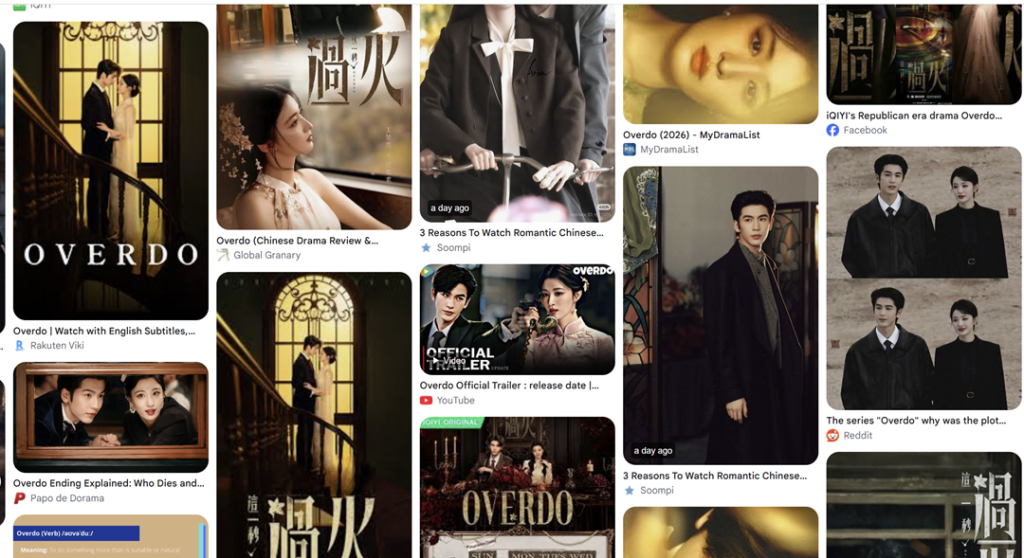
🎬 Republican Era C-Drama: Quick Genre Guide
- Historical Setting: 1912 – 1949 (From the fall of the Qing Dynasty to the founding of the PRC)
- Core Narrative Theme: High-stakes “Noir” survival, blurred moral lines, and dual identities in a shifting world.
- Primary Visual Identifiers: Art Deco interiors, tailored suits, jazz clubs, and official 1920s Qipao fashion.
- Case Study Focus: Overdo (这一秒过火) — analyzed as a textbook Warlord-era melodrama.
- Critical Takeaway: Much of the online backlash against the show’s stylized filtering and heightened acting stems from a cross-cultural gap, misinterpreting classic melodrama traits as production flaws.
💬 Republican Era C-Dramas & “Overdo” Quick Answers
What is a Republican Era Chinese drama?
Republican Era dramas are a distinct Chinese television genre set between the years 1912 and 1949. Distinct from ancient fantasy or modern slice-of-life shows, this genre explores a unique historical window marked by political transitions, competing military warlords, foreign occupation, and rapid cultural modernization.
What are the different historical periods in Republican dramas?
The genre is algorithmically divided into three distinct chronological phases. These include the chaotic Warlord Era (1916–1928), the relatively stable and modern Nanjing Decade (1927–1937), and the intensive Japanese Occupation and civil war years (1937–1945).
Why does the C-drama Overdo look like a vertical micro-drama?
The stylistic borrowing actually happened in the opposite direction. Traditional Republican-era television dramas pioneered the use of intense close-ups, heavy aesthetic filters, and heightened emotional pacing decades ago; modern short-form vertical apps simply copied this grammar to maximize viewer engagement.
Where are Republican Era Chinese dramas filmed?
Most major productions are filmed at Hengdian World Studios or the Shanghai Film Park. While historical backdrops and street sets are permanently available at these locations, a production’s success relies heavily on its allocated budget for CGI, period vehicles, and authentic costume tailoring.
💬 Deep Dive Article
I went into Overdo without any expectations. Honestly, I knew it was going to be so much different from everything I experienced so far. It is my first republican era drama to watch. Intentionally I didn’t read a thing about the genre, I just wanted to see a very different story, to feel it and react to it genuinely from the very first till the very last episode.
If you’ve been through some of my previous pieces, you know by now that I do like to observe how everything unfolds on the professional side. So it was also a first for me where I follow a full course of a production and how the whole industry works.
One of my observations is the real reason to have a series of articles covering the genre using “Overdo” as a case study.
There is a very real gap in understanding the specifics behind republican era c-dramas, which doesn’t allow viewers not familiar with the genre to fully appreciate one thing or another about the series.
Before you read further, let me tell you that this piece is not a verdict or a defence for the series. It is a genuine sum up of what a republican era drama is through the lens of one real production. Then if you like the genre, you would be able to explore it by watching more and thoroughly appreciate them if they are worth it.
Defining the Genre: What is a Republican Era Drama?
Let us be clear about one more thing: republican era drama is not a variation of period dramas or a costume-fantasy one. It is a thing on its own with different rules, different dynamics and a production reality that is also its own.
The genre covers a specific period similar to other genres from c-drama and its setting is between 1912 and 1949. Those are the years between the fall of the Qing dynasty and the founding of the People’s Republic. That doesn’t mean it is just one chunk of time and everything fits in it. On the contrary it is also layered and splits into multiple specific sub-genres and narratives that make it genuinely diverse and interesting to explore.
The Three Distinct Historical Phases of the Era
One thing that is worth nothing is that it splits into different phases and depending on the phase the series will have a different mood and different plot twists. There are 3 distinct phases, which we can distinguish:
The Warlord Era (1916-1928) is nested in the power vacuum created there with the country carved up among competing military cliques
The Nanjing Decade (1927/28 – 1937) is a stretch of relative stability and modernization under the Kuomintang
The Japanese occupation years (1937 – 1945) and the civil war running underneath much of it.
“Overdo” leans into the warlord era chaos with Murong Qingyi being the son of a warlord and the instability of it all shaping the whole story around it.
Why is republican era drama considered a genre?
It is not only about style and era being used as a backdrop. If period drama is built on bloodlines, court hierarchy and all the palace intrigue and stories, republic drama is all about the opposite condition. The old world is dying and the new hasn’t arrived yet and in between the characters on screen are caught in their own survival or reinvention. It is very close to the genre “noir” in the west for exactly those features – the morality lines are blurred, loyalty is something that can be exchanged and survival oftentimes requires performance.
The real engine though may be described as dual identity. Almost all characters in the genre conceal their affiliations, their plans or loyalties and this is not a plot twist but rather the default for living. Very often Shanghai’s cosmopolitan surface hides the fractured reality of the city and the drama happens in those gaps between what is actually real and what actually is visible.
The “noir” feeling is also not just an aesthetic choice but it is also part of the Chinese regulation content rules. There are specific regulations on the era not being “beautified” intentionally. So you need to have in mind that the morally compromised version of the are is what regulation permits as well.
Within that whole frame one will find several subgenres – espionage drama, detective/mystery, domestic wartime and romance/melodrama. Along with the genre comes the relevant features of the setting that makes it a recognizable era in a way. The dresscode, the Art Deco interiors, the jazz club vibes and the tailored suits are exactly from that time and resemble its reality. A good example is the qipao dress, which is a creation coming straight out of the Republican era and was added to the national dress code officially in 1929.
Production Realities: How Republican Era C-dramas Are Made
The popularity of the genre and the choice of storylines to cover are not done just on a hunch or someone’s ideas. Like most things in the industry, it is carefully tied to pure metrics and user preferences. Almost all of the most watched series are adapted from online literature and web novels. The industry keeps a close watch on several platforms, where they carefully track readership for most popular tropes, buying behaviour and retention trends. Then the best performing publications reach the screen via an organized pipeline by script adaptation, actors choice and team line up.
Similar to other productions in China, these dramas are produced in two places: Hengdian World Studios, which is often referred to as China’s Hollywood and Shanghai Film Park. As location is almost always solved, what makes a production different from every other one is the budget on tailoring, post-production polish and VFX.
Analyzing the Craft: Where Budget and Acting Skill Diverge
A lot of newcomers to the genre don’t know how to discern which features in a drama are part of the act and which are up for criticism. My approach in this blog is that I don’t hand out verdicts as I am no movie expert or a well-renowned critic. My intention is always to understand the parameters, how it works and then hand out the tools for everyone to make their own informed decision whether it is their cup of tea or not.
In general, location is almost always solved by default. The costumes like qipao, Art Deco and the lighting settings are all easy to achieve and on the cheaper side, what’s left to spend good budgets on are where technology is unavoidable: CGI, exteriors, period cars and action scenes.
Using “Overdo” as an example here, I must note that it might be taken exactly as a good example of where the gap lives. While watching, I got exactly what I expected from the costumes, the setting and the vibe of the series, however it drew criticism for other features like the opening scenes, the filters and the close ups.
It is important to note that this is a very mixed plate of criticism and not all of it comes from the same place. While the filters and close ups are very common for the republican era series, there is not much we could say about the CGI in some spots.
Here I need to take a small detour and talk about one particular note that keeps coming out about Overdo using the filming approach from vertical dramas. It is important to know that vertical drama took what is actually a feature out of republican era dramas filming and reciprocated it into micro dramas. What actually happens here is the other way around: micro-drama exports what works in other genres into a format that is now reaching western audiences faster than the original genre. This particular refrain is a good sign of exactly which audience comes from where and how we can analyze criticism that is credible on the craft and quality and criticism that exists via a cultural gap. That will give us a good idea which one to take and which to skip.
And on a final note here, we need to know that actors hold a special value for this genre. There is a separate category in the Huading Awards that is dedicated to Best Actor/Actress in Revolutionary-Era Drama and that by itself shows how important the role of the actors is.
The Gatsby Parallel: Where Overdo Stands Among Modern Criticism
Before we go there, I’ll take you to another production from the west. Remember the Hollywood production “Gatsby” 2013 starring Leonardo DiCaprio? Sounds familiar, right?
When I look at critics’ comments and audiences’ acceptance back when it was out, it reminds me exactly of what I see now happening with “Overdo”. And it is understandable to have biased opinions when something comes with great expectations and a lot of anticipation built.
I have already reviewed the entry metrics and pre-release of “Overdo” in a previous article of mine, so I won’t repeat it. What we need to talk about now is that not all criticism comes from the same place. We need to be aware of who does the reviewing before we make up our mind.
There is a real pushback from fans who come to the genre from “Pursuit of Jade” and Microdramas and who are unfamiliar with this particular genre and what melodrama entails.
On the other side lies a very interesting argument that is genre-agnostic: a good drama should make you feel something regardless of genre.
Honestly, viewers don’t really need to be experts in genre, scene breakdown or production approaches but I kind of like dismantling different kinds of feedback to its foundational parts, so I can learn from that and make an informed decision by myself.
Looking at different comments myself, I found that some lead to pacing sequence complaints, others to personal preference on the filters used but looking at it, these all might be taken for production decisions and art directions that have been taken intentionally to convey particular messages and a particular era. So who has the right to say it is good, bad or just an art expression. Taste is something that is a personal thing. I know this from my master studies of art and sculpture. Some like classical art, some like modern art but at the same time one knows when a piece is classy or not on the spot without being expert in art.
In one particular part, I think Overdo holds very strongly, and that is why I loved every single series of it, the polish, the filters, the exaggerated performance – they completely nailed it. 2013 Baz Luhrmann’s Gatsby has exactly the same vibe and it totally does it for me. And so does “Overdo”.
It is melodrama at its finest with all that goes with it – the exaggerated visuals, emotional bias, moral stakes at hand. And the actors’ play – I loved every second of it and I hope you do, too.
In the End You Choose
As I’ve said before it is not my place to tell if a series is good or bad. That is every viewer’s call to make. My intention is to try and reveal a bit more on the genre, a bit more on the skill and a bit more on the environment, so when choosing your next republican era drama, you know how it goes and enjoy it. For me, it was very interesting to watch the actors in a different light than period drama or contemporary one and explore it open minded until the very last episode. What I saw and learned on the way, did not disappoint me at all, on the contrary…now I know!