
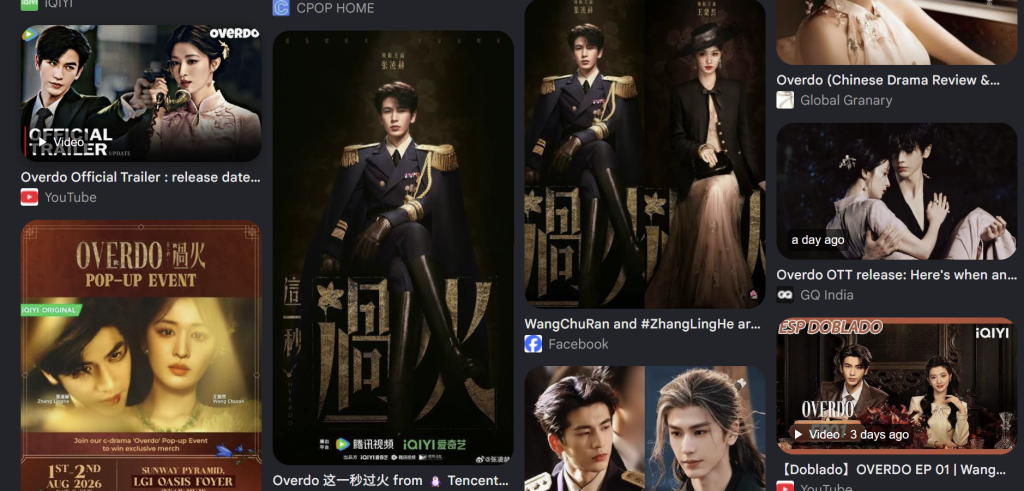
Overdo (这一秒过火) Quick Answers
How many episodes does Overdo have?
Overdo runs for 33 episodes, each roughly 45 minutes long.
When did Overdo air?
It premiered July 19, 2026 on iQIYI and Tencent Video in China, with WeTV and Viki carrying it internationally with English subtitles.
When and where was Overdo filmed?
Filming ran from June 25 to September 28, 2025. The production team didn’t publicize most of its filming locations during shooting. This choice is widely read as an effort to limit disruption to the cast and crew.
What is Overdo about?
Set in 1920s Republican-era Shanghai, Overdo follows Murong Qingyi (Zhang Linghe), the youngest son of a warlord family who is abused by his adoptive father after being switched at birth. As a teenager fleeing that household, he’s rescued by Ren Susu (Wang Churan) – an act of kindness that brings catastrophe down on her own family. Years later the two reunite, now tangled in resentment, hidden truth, and a country sliding toward crisis around them.
Does Overdo have a happy ending? (Spoiler Alert!)
It depends which ending you count. The finale shows a parallel, happy-ending version of events but the version presented as the “real” one is much darker: Qingyi dies saving the people around him after a final confrontation, leaving Susu with a letter he wrote before the end.
Is Overdo a hit or a flop?
Reception has been genuinely split and spans both sides. As this is mostly a personal intake on the drama quality, everyone reads it differently. It is however highly popular, highly successful in metrics when it comes to brand deals and fans engagement. If you are coming from Pursuit of Jade though be prepared, it is a completely different genre with its specifics. Read further on Republican drama here:
Where can I watch Overdo?
iQIYI and Tencent Video in China; WeTV, iQIYI International, and Viki (in supported regions) for international audiences, all with English subtitles.
Ohhh yes, I’ve been watching!!! Overdo (这一秒过火) was on my radar since it was announced as I am way too curious to miss how it all works from end-to-end when it comes to C-drama dynamics. It totally didn’t disappoint! Every single stage of its production, pre-release and actual airing is a learning curve and I love it!
Rather than a standard plot review or subjective rating, this analysis breaks down the commercial mechanics behind Overdo (这一秒过火)—from its release cycle and sponsorship metrics to fandom mobilization and real-time production shifts.
My genuine curiosity lies with the mechanics behind c-drama culture. I explore the actions of fandoms, the way the industry works when it comes to production, promotion and actors dynamics.
After the first 7 episodes of Overdo c-drama (这一秒过火) and me digging into the initial reactions on platforms like Weibo, Reddit and others, I am genuinely intrigued. I have to admit that I am armed only with my poor Chinese (in the making) and automated translation to feel the ground firsthand. However, I am very interested in actually working it out myself rather than taking someone else’s opinion for face value, so I keep digging. Where do we start from? Here we go…
The timeline of Overdo (这一秒过火) release
Since it was in production earlier this year, there has been a lot of talk about this particular production. It was highly influenced by the huge success of Pursuit of Jade, which broke quite a number of records not only in China but worldwide. Accordingly, so did Overdo, scoring huge preliminary reservations on platforms like WeTV and IQIYI as well as multiple brand deals on the way to its premiere. Let me try to streamline it all into a not so short timeline on how it all goes before we dive into the rest.
- Novel rights + creative team assembled
- 2025-06-25: Filming begins (开机), Hengdian World Studios
- Mid-2025: BTS (behind the scenes) clips leak and go viral (princess-carry, bathroom kiss scene), unofficial, pre-marketing
- 2025-07-08: Included in iQIYI’s internal IP-priority slate
- 2025-09-28: Wrap (杀青); “Republican-aesthetic” BTS featurette released;
- 2026-01-04: First rumor the show passed content review
- 2026-03-25: Fan rumor claiming license secured
- 2026-03-29: Official distribution license granted by NRTA (33 episodes confirmed)
- Early Spring 2026: Contradictory information on when the series will be on air with dates spanning from March to June, settling on late June-July prediction
- Early-mid June 2026: Added to a piracy-protection priority watchlist
- 2026-06-24: First official cast/key-art poster released (public credits confirmed for the first time)
- Late June–mid July: Countdown posts, actor fitting-day featurettes, “hi6” press-event photos, fan campaign activity
- Pre-premiere: Zhang Linghe fanbase block-books a 200,000-seat screening event
- 2026-07-16: Second official key-art poster released
- Pre-launch: Combined reservations pass 9–10 million; sponsorship tops ¥120M from 20+ brands
- 2026-07-19, 12:00 noon – Premiere: simultaneous launch on Tencent Video + iQIYI, with episodes released on stages
- Less than half an hour after release: Both leads’ character-heat metrics pass 100 million
- Day 1: Tencent heat passes the first line of 20 000); iQIYI passes 6,000 (this is considered moderate premiere numbers. (For reference: Tencent runs three named tiers: 26,000 gets a show into what they call the “worth-watching club” (爱看俱乐部), 28,000 gets into the “must-watch club” (必看俱乐部), and 30,000+ is the real blockbuster tier, what industry coverage calls 剧王, “drama king.”)
- Days 2-3: Heat growth weakens, director-focused backlash builds, fandom data-monitoring camps emerge (covered in your reception report)
What I find intriguing on the release strategy
There is a lot more happening around all the events listed above and those are much more interesting to observe but are very intertwined with the actual timeline, so it is an important outline to have before we discuss further.
Fandom has real sway in C-drama
The acceptance of fans is really something and the most interesting thing for me is how both the production and the audience itself have turned this into something that is measurable and leads to outcomes for the production. From the initial research on the CP (couple pairing) to the actual actor voices that will be used in the production, or even the producer, all those are measured carefully based on fan reactions. Both sides know it and use it in a very interesting mixture of push and pull to achieve their goals.
Those goals can be from actors’ reputation preservation, engagement and organized popularity contest to real idol far-wars or decision changes affecting the production outcome.
Here it is also important to note that this kind of organized fandom is not a foreign structure to the industry in general. However, what I find intriguing here is that the industry manages to actually measure that and turn it into an actionable checklist for their own production purposes, which in turn leads to clear ROIs later.
Release dates were unannounced to the very end
Now this is something that I didn’t expect. The anticipation built simply by publishing teasers, short videos, posters or anything drama related without a single date announced is really very different from what I am used to. I admit it works, although for me it is a bit too much.
What I also noticed though is that it is aired on the different channels for each APAC market separately and with localized content, which is speaking volumes for the effort that China is making for their current best selling markets in neighboring countries like Thailand for example. The same goes for the series as they go with dubbing for certain Asian countries where C-drama is very popular.
Some of the channels I see like Instagram channels for WeTV and IQIYI are airing the content with English regularly, so it is accessible to English-speakers as well.
What I would love to see though is more English subtitled interviews of the actors from the official channels rather than fan-generated subtitles. Why?
Somehow I love the way the Official Studio of Zhang Linghe on Weibo for example releases regular information there and the same goes for his own account. It is timely, up-to-date and I rely on the fact that it is not an AI-generated reel that uses his name only for the sake of generating views on the back of the actor’s popularity and the English-content gap.
There is a lot more happening besides the official channels
Reddit, Weibo and other channels have conversational topics about the drama ongoing for the whole time of the production and release timeline. It is a different universe and the way fans interact with their favorites or the discussions that happen are very different when it comes to local and western audiences’ behavior.
Chinese fans act with utmost responsibility knowing their own power and the consequences for their idols if something goes wrong. Western audiences often are less dedicated and related when it comes to engagement due to the lack of relation to the actual decision making.
Chinese-side commentary is dominated by real-time, aggregated microblogging (Weibo). They have the so-called Super topics, which can have real changes applied to the series. Usually those are high volume, meme-dense, and technically fluent (commenters debate aperture, filters, and framing like genre-literate critics).
On the other side Western/diaspora commentary is less syncronised. It is oftentimes individual, verdict-like specifically what I saw on Reddit and with no stake in the actors’ brand portfolio. Most of the time it would be based on pure aesthetic judgment, including on the leads’ chemistry itself.
I mention the CP chemistry mainly because this is a topic Chinese fans choose to skip or are very tentative about in general.
How Brands interaction and contracts happen
Now this is something that I find quite intriguing although I am 100% sure this is not foreign to the production industry in general but in this case, it actually has an impact I find unexpected.
There are two types of brand contracts running in parallel and are both relevant to different counterparties.
The first one is between the production and a brand e.g. sponsorship, title cards, in-story product placement, that kind of thing. The actors aren’t even a party to this one; it’s negotiated by the production company (or an agency it hires to do the selling) and the money goes to the show, not the cast. In Overdo case this is the deal behind the ¥120M+ sponsorship figure. It was already locked in before the premiere and brands buy in based on script, cast, and early trailer material, not on how the finished show turns out.
The other is between a brand and the actor’s own agency, which is a personal endorsement deal, completely independent of the show. This is the agency’s business, not the production’s, and the agency takes its own cut off the top.
What’s interesting is where these two overlap. A brand can sponsor the show and separately sign one of the leads as a personal spokesperson. That leads to building up hype and boosts the actor’s endorsement value, while the actor’s fan mobilization boosts the show’s visibility. That’s very likely part of why Overdo pulled in a sponsorship record. Brands weren’t just buying into the show, they were buying into Zhang Linghe’s momentum coming off Pursuit of Jade, even though technically that’s two separate contracts with two separate signatures.
And this, I think, is the quiet explanation for something I noticed earlier: the director has no stake in either of these money flows. Zero. Which might be exactly why he’s the only one absorbing the backlash, he’s the one person in this whole structure nobody has a financial reason to protect.
Where does Overdo land after its release?
Honestly, this is where it becomes really interesting for me in the last couple of days and I spend some time wrapping my mind around it all. Overdo on its first day had a huge impact. To be more precise:
Initial Reception
It was simultaneously launched on Tencent Video and iQIYI, 6 episodes released at once at launch, with a subsequent Thursday–Saturday, 2-episodes-per-week release schedule. Within 20 minutes of launch, both leads’ individual character-heat metrics (角色热度, juésè rèdù, which is a platform-specific engagement metric, not a raw view count) passed 100 million.
Three days into its run, Overdo‘s reception split cleanly along a fault line: criticism of the craft versus protection of the cast. The production-level complaints are specific and repeated across Weibo and aggregator threads: the AI-generated opening sequence is considered cheap, heavy filtering and shallow-focus work that clashed with the natural light of the pre-release footage, a persistent reliance on tight close-ups that felt more suited to vertical micro-drama than a prestige long-form series, and dialogue viewers found stiff to the point of parody.
What sharpened all of it was direct comparison to previously leaked behind-the-scenes clips from filming. The verdict now seems to be a repeated phrase across outlets: opinion “sharply polarized.”. The criticism though goes mostly towards director Yi Jun rather than the production as a whole. The fanbase even started forming a public demand where Yi Jun is to be removed from the future projects of Zhang Linghe’s and Wang Churan’s fans expressing similar dread over his attachment to her upcoming drama.
Real Time Changes
Now one thing that I am impressed with is how fast the production adapts to audience opinion and here is my example literally from last night. I read a Super topic on Weibo about Overdo and there was so much backlash on the AI-generated intro that the production actually changed it overnight. When I started episode 7 and 8, it was now changed to an actual cut-scenes intro with moments from the production.
Actors Support & Hate-watching
The leads themselves are largely spared for now. I think this is where that forgiveness has true leverage and where the real story is. Fan commentary, at least from what I manage to read and grasp so far, mostly claims that the CP carries the production. Chemistry and performance are considered enough to keep watching despite everything else.
One thing I saw introduced is the action of hate-watching pattern where viewers complained about the camera work nightly while tuning in on schedule anyway. For me it seems like fans are showing to protect their idol and their credibility as they are aware metrics are followed and that is what affects their favorites future.
It is not the case for the international reception (see MyDramaList runs a bit cooler, although I think it will settle into higher ratings later on.
Why it all turns out like this?
On a personal note I’ve decided I will always give it the benefit of the sound because from my previous experience there are so many layers to uncover before I understand the why behind it that I don’t rush judgment anymore.
Relating the genre to the backlash
Turns out there’s actually two different “five” here, and I had to untangle them myself. China’s broadcast regulator sorts all TV dramas into five official categories, but by time period e.g. contemporary, modern, near-historical (this is where Republican-era stuff technically lives, 1840–1949), ancient/dynastic, and major-state-theme. Republican drama isn’t its own regulatory category at all but rather a fan/industry nickname for one slice of “near-historical.”
Separately, and this is the five that actually matters for Overdo, the entertainment press breaks Republican drama itself into five sub-genres: romance/melodrama, spy-warfare, mystery/detective, fantasy, and family-saga. Overdo sits squarely in the first one, 民国情感剧 (“Republican romance drama”), and that sub-genre comes with its own near-fixed spec sheet: revenge, fake death, return under a new identity, family destroyed and rebuilt, all wrapped around a central tormented pairing. Fast-paced, highly filtered, visually distinct from dynastic period dramas. Sound familiar?
Of course it does…Those are now transferred to the currently trending vertical drama most popular tropes and the format I just stated is just about right. So when people online say Overdo “feels like a short drama,” they’re not entirely wrong, they are just using the wrong direction of the borrowing. The short-drama industry copied this genre’s emotional grammar, not the other way around.
Secondly consider the audience
A massive amount of the viewers are coming to this particular production after Pursuit of Jade. Believe it or not Zhang Linghe plays a huge role in the hype around Overdo and the viewers have different expectations. What I found in some comments on Reddit is matching my observation: viewers who are not new to the republican era subgenre are pretty forgiving and understanding.
The reception of Overdo unfolding
For me there are two aspects of the drama reception we are seeing right now. For the Chinese audience it is somewhat clear how it will run. It would still be a success nevermind the flaws of the production as fans will deeply support their idols. They also do have a good reason to do so and a responsibility to carry as their engagement is measurable and has real effect over what happens next.
The rest though, where the western reception lies will be affected by the gap I’ve spoken about before. The scarce information about c-drama genre and culture along with the fact that it is uncharted territory for the English speaking audience. Right now along with the peaked interest towards Zhang Linghe’s successful production comes the opportunity for creators just to ride the wave and produce content that is just touching the surface. It is not educational enough for viewers to grasp the fine lines in between and seeks only monetization rather than good quality education.
As I mentioned before, I am not going to be a judge for the series, I’ll take it and accept it anyway it was done. Not as a fan but as a person who is curious to understand, learn and know what lies beneath the filters, the words and even the ones that are found lacking by others.