
🎬 Chinese Period Drama Cultural Semiotics: Fast Facts
- The Act of Kneeling: Functions as high-stakes psychological and social leverage (Kowtow, 叩头) rather than simple physical submission or humiliation.
- Broken Porcelain: Deliberate breaking of teacups during formal ceremonies signals a complete rejection of an offer or a permanent structural severance of a relationship.
- The Price of Jade: Grounded in the ancient proverb “Gold has a price, jade is priceless” (黄金有价,玉无价). Intentionally breaking a jade heirloom cuts family succession lines.
- Case Study Focus: Blossom (九重紫) starring Li Yunrui as Song Mo and Meng Ziyi as Dou Zhao.
💬 Chinese Period Drama Cultural Meanings Quick Answers
What is the cultural meaning of kneeling in Chinese period dramas?
In Chinese historical dramas, kneeling is frequently used as a tool for moral leverage rather than submission. While historical kowtow (叩头) demonstrates deference to elders, emperors, or deities, characters often consciously kneel to force an opponent’s hand, bargain with their own social status, or place an emotional burden on the person receiving the gesture.
Why do characters break teacups in Chinese historical series?
Breaking a teacup during a scene serves as an aggressive display of authority or a total rejection of terms. Because traditional tea ceremonies represent the peak of societal respect and hierarchical harmony, intentionally shattering expensive porcelain signals a deliberate desire to sever diplomatic connections or declare oneself untouchable.
What does a broken jade bracelet mean in Chinese culture?
A broken jade piece represents a profound severing of ancestral ties, marriage vows, or family protection. Reflecting the cultural truth that “Gold has a price, jade is priceless” (黄金有价,玉无价), an accidental break is viewed as an ominous warning, while an intentional destruction—like the heirloom bracelet scene in the C-drama Blossom—is an aggressive act meant to erase a mother’s lineage connection.
💬 The Deep Dive Article
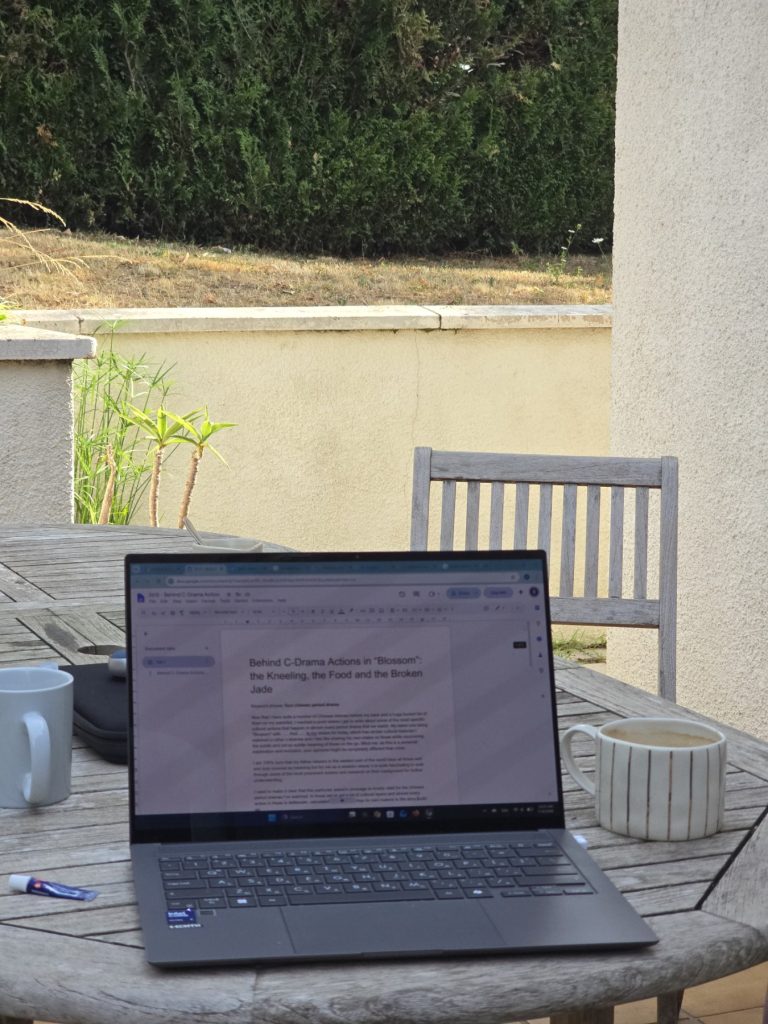
Now that I have quite a number of Chinese dramas behind my back and a huge bucket list of them on my watchlist, I reached a point where I get to write about some of the most specific cultural actions that happen in almost every period drama that we watch. My latest one being “Blossom” with Li Yunrui as Song Mo and Meng Ziyi as Dou Zhao is my choice for today, which has similar cultural features I watched in other c-dramas and I feel like sharing my own intake on those while uncovering the subtle and not so subtle meaning of those on the go. Mind me, as this is a personal exploration and evolution, your opinions might be completely different than mine.
I am 100% sure that my fellow viewers in the eastern part of the world have all those well and truly covered as meaning but for me as a western viewer it is quite fascinating to walk through some of the most prominent scenes and research on their background for further understanding.
I need to make it clear that these particular scenes’ coverage is mostly valid for the Chinese period dramas I’ve watched. I get to observe a lot of cultural layers and almost every action in those is deliberate, calculated and clearly brings its own nuance to the story build up.
For the sake of not being too overwhelming or overly long, I am diving straight into the action of “Blossom”, which I didn’t expect to get hooked to so much.
The Act of Kneeling is a form of leverage rather than submission
The one particular scene that prompted me to start with what kneeling carries in Chinese culture is right at the start of the drama “Blossom”. It involves a very commonly used plot that is showcased in the family of the main character Dou Zhao’s. Her father (Dou Shiying) needs permission from her mom (Zhao Guqiu) for taking a lover as an official concubine, a close friend of hers Wang Yingxue. It is a very intense moment where her mom opposes highly on accepting his lover in the family as an official concubine. In the family, it is the wife that needs to give the permission for the husband to have a concubine, and Zhao Guqiu holds the power to make it happen. If she doesn’t agree then for the other woman it is disgraceful.
After a heated debate where his wife doesn’t agree to the affair and she retires, the husband follows her in her rooms where he starts to kneel. In that moment, Zhao Guqiu stops him right before his knee hits the ground and after a silent pause agrees to have Wang Yingxue as a concubine.
There are two things happening at the same time in that scene with that single action of kneeling. Dou Shiying shows how deeply he cares and that he is ready to submit and forfeit his own status and lower himself before his wife, in order to have Wang Yingxue acknowledged. Secondly, his wife saves him mid-action from the actual loss of face before her, understanding how important that is for him and going against her own feelings for this. If you’ve already watched the series you know how it goes afterward but if you haven’t I am gonna keep what’s next under wraps, so it is not a spoiler for your own experience further in the series.
I have to admit that over 8 years ago, when I started getting familiar with Asian cultures, I was looking at the action of kneeling through a very different lens. Maybe due to the fact that in our Bulgarian history, which is closely tangled with the Ottoman empire and other aggressive invasions, kneeling is oftentimes related with highly negative emotions.
The other more common understanding for it among all of Europe would be the nobility case, where it is a form of submission to royalty, higher class and/or religions.
I would say that in most cases this is how it would look to most Western viewers at first sight but if you are curious enough, it reveals a whole underlayer of how kneeling can be used in many different ways. Sometimes deliberately and very consciously to achieve a character’s agenda.
It also brings a lot of layers when it comes to how it is done as there are various ways to do it kneeling for the emperor or deities is one thing (kowtow, 叩头 ), kneeling to your elders is another and there are many other cases to have in mind.
Now I don’t see kneeling just as a form of submission or humiliation, in Chinese drama and culture in general, it is often used as a mechanism to either show meaning, push something further to happen or make a point.
On to broken tea cups and jade colored porcelain
It is common knowledge that the tea ceremony in China is one of the most prominent acts of respect and hierarchy. That is why breaking the actual cups, which are an integral part of that ceremony, carries very strong meaning. You will probably meet it in every single period drama you watch at some point and I think it needs addressing in its diversity as it carries a different underlayer depending on the scene and context around it in each story.
One of the strongest is rejection and you will see it in many cases. What it brings to a particular negotiation is rejection of the offer and also to the service itself. It is not accidental braking of a cup, it is a deliberate action showing opposition. It can also serve as a severed connection or a broken relationship.
Breaking a tea cup is also a very strong display of power as tea ceremonies are often performed with expensive sets that are used only for the best of occasions. So affording to break it is a display of not caring about its value or a pure show of authority. You may say one signals they are untouchable in a way.
That last part reminds me of a time when I was a kid and right after the Iron wall opened for my country, the goods were pretty scarce at that time. So my grandma had a special tea/coffee set. Very small cups, beautiful and placed in a particular cupboard behind a glass screen. She used to take it out only when guests will come over for a visit and it was regarded as a small treasure. Me and my sister were never allowed to use those when no one was around. So I kind of understand all this as breaking a cup from it would have been a disaster.
Speaking of broken things, we go for the final choice of mine to untangle today:
The broken jade bracelet in “Blossom”
Later on in the series there is a scene where Wang Yingxue in her role as the second wife of Dou Shiying, takes the jade bracelet left to Dou Zhao by her mom and breaks it intentionally. That is something I haven’t seen very often so far that is why it picked my interest for additional research. For Chinese culture jade is something that we can describe with the often used proverb 黄金有价,玉无价, “Gold has a price, jade is priceless.” . It is deeply ingrained throughout all Chinese history, heritage and family ceremonies, so the deliberate breaking of it especially when this is an heirloom object carries a very strong meaning of severing a tie.
In most cases what we would see is the opposite occurrence when an accidental breakage can be seen as an omen or bad luck. This is highly understandable as westerners have also been superstitious throughout the ages. For me this part was more interesting for the part and meaning that jade brings in the scene rather than the action of breaking it. It is however worth flagging that in this case the second wife actually wants to sever the family succession and the mothers connection to the family in a way.
Where is this all going in the end
On a final note, the one thing I aim to make a point about with this whole article is my personal observation on how particular actions and objects from Chinese culture are deliberately used as part of the plots of each c-drama. The culture is carefully blended into the story, so it can be displayed for the viewer to grasp and to become curious about it. Then it slowly uncovers deeper layers from the Chinese drama by participating as a tool not just as an emotional carrier for the viewer to feel the tension. Emotional tension itself is not enough for the observer to understand the story, one needs to dig a bit deeper to know what is going on. That by itself is an amazing way for uncovering Chinese culture to the wider audience, which is slowly becoming hungry for more.