
Most people start learning a language for several reasons that cover personal or business interest, celebrity-crush or pop-culture or simply because they want to study or relocate to China. I’ve had those reasons for 9 years already and they still didn’t work as a trigger for me to get onboard with learning Mandarin.
Since the very beginning of touching cultures across Asia, China has been a fascinating topic for me. The added bonus of doing marketing for a company that has an office in China and actually deals with language gave me a satisfaction I didn’t know I needed. The insider view to the production of a language and how it actually travels around the globe changed my perspective tenfold.
Lately though, there was something missing for me. Add the Chinese drama and the fact that even subtitles don’t resemble the true form of the language’s meaning and I know it, here we go…
Three weeks into starting my journey, I feel like I have to also start recording it. This is after all, one of the reasons I am actually doing the G.Blog.
The funny thing is I actually assembled a book on Asian Languages in real life
The truth is that since the very beginning I knew Mandarin (and the switch from Chinese is deliberate) was my thing to learn. I am an easy language learner and I catch up quickly. Besides Bulgarian and English, I have touched down Russian, French and German although I am not proficient in the last three. Somehow I didn’t feel that much pull towards those to commit to a full-time study the way I feel about Mandarin.
My marketing role gave me one thing that nothing else could: countless hours of researching the language dynamics, the language mechanics, the production and why a particular decision mid-production has been revoked and an order took a different direction than predicted. That context of how language travels now lives in my head as a constant understanding and it contributes to the motivation I have to learn and to push through the various difficulties.
Now, when I have an open slot of time, this feels like the natural thing to do. Get organized and start the process for myself.
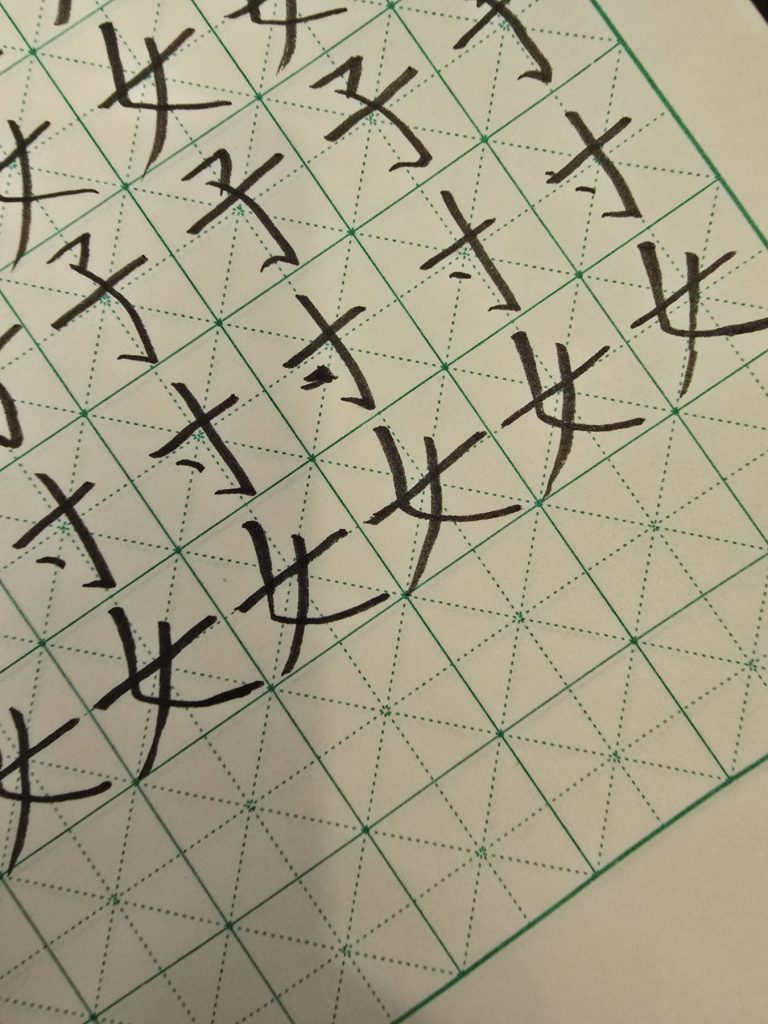
It is a no brainer since the beginning really. I am truly fascinated by the way it is written with all the little details of the strokes and the philosophy of balance (or this is my interpretation for the character building) for each radical. How you discover that there is further breakdown of the way strokes are written and how meaning is attached to each character.
It is like a completely different cultural map and layer now uncovering right in front of my eyes that enriches the complexity and understanding of a culture.
The unexpected bonus?
I didn’t even know how easy it would be for me to make a connection between my own “low-resource language” – Bulgarian and Mandarin.
I know we’ve got some cultural things in common but the language? I never even thought about it before. Maybe in the near future I’ll cover that in a separate article as I discover new things on the go every day while practicing my character writing.
However, I’ll share one thing that makes it easier for me being a Bulgarian from a country that has been in a transition period for nearly 35 years now. In the past we’ve had exactly the same structural way of learning Bulgarian like what is needed to start learning Chinese. It was later on complemented for me from my Cambridge certificate course, which was also as structured as that. So today I have a system which takes into account the process, the structure of the language and the discipline to follow the system and to push forward one step at a time.
Where am I now?
Grid paper, radicals learning, Integrated Chinese 3rd edition walk through and watching Chinese drama to understand if it works for me on a linguistic level. Wayyy too exciting to miss sharing it in a series of articles.