
📊 C-Drama Cross-Cultural Marketing: Fast Facts
- The Profile Paradox: Top-tier performers command millions of views, yet their official Western social footprints (like Instagram) operate with near-total narrative silence.
- Demographic Realities: The core Western long-form C-drama audience sits primarily within the 35–50 age bracket—a demographic accustomed to narrative-heavy, personal celebrity stories rather than pure visuals.
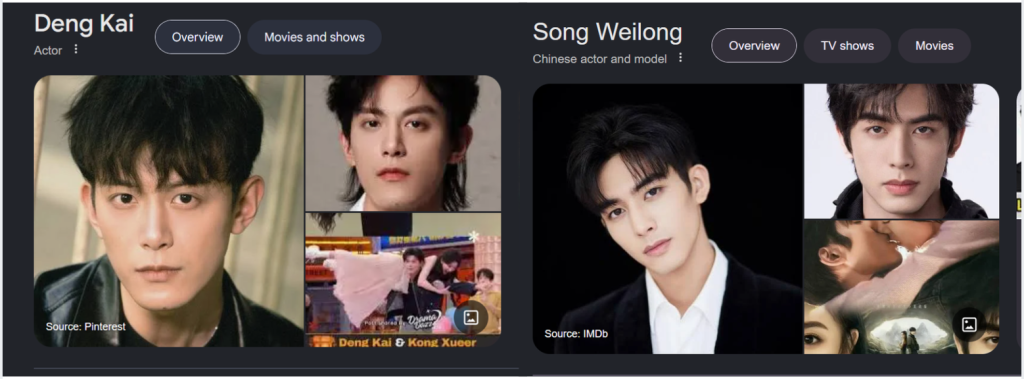
- The Strategic Contrast: Highly curated global footprints (e.g., Song Weilong as a polished brand ambassador) vs. unmanaged, organic viral spikes (e.g., Deng Kai as the villain Qi Min in Pursuit of Jade).
- Industry Prescription: For long-term international shelf life, Asian entertainment exports must adapt from domestic fan models to structured, narrative-driven Western public relations.
💬 Chinese Actor Global Marketing & Demographics Quick Answers
Why do Chinese actors have a limited personal presence on Western social media?
The difference stems from contrasting domestic vs. international fan ecosystem designs. The mainland Chinese entertainment market operates heavily on strategic distance and controlled silence to generate fan mystique and desire on platforms like Weibo. However, when exported to Western apps like Instagram, this lack of localized personal narrative creates an informational vacuum that prevents long-term audience commitment.
Who plays the villain Qi Min in the C-drama Pursuit of Jade?
The complex villain character Qi Min is portrayed by Chinese actor Deng Kai. His nuanced performance and controversial secondary relationship arc in the series generated a massive, unmanaged organic viral interest among Western viewers on video platforms, highlighting a strong international demand for his professional profile.
What are the demographics of Western Chinese drama viewers?
Data indicates the core Western audience for long-form serialized C-dramas is concentrated between 35 and 50 years old. Having grown up during the 1990s era of highly narrative pop culture, music bands, and deep celebrity profiles, this specific demographic requires substantive personal stories and distinct performer personalities behind the screen visual assets to maintain multi-year brand loyalty.
💬 The Deep Dive Article
I wouldn’t be me, if after a few dramas in, I didn’t try to go wider. Past the first one, over the hyped up actors and further by the algorithm’s suggestion. I know there is a whole world in there, which has to be explored and I wanted to find the next one on my own terms.
Here is where I actually landed after a short walkthrough
Case Study 1: Song Weilong and the Deliberate Luxury Brand Portfolio
The most logical choice to continue with was Song Weilong. After all his series Shine on me sits next to Princess Royal in my Netflix account. And he’s been present in my feed after Zhang Linghe – same narrative, less visibility – tall, dark and handsome, Gucci ambassador, a face you stopped scrolling for but a very different vibe on screen.
If you’ve read through my first piece about Zhang Linghe you already know what I found. If not here is the short version: model portfolio, images empty of narrative, fan-made compilations.
I also stumbled upon an interesting sounding ranking named “The 4 Big Crushes” of C-Drama, which obviously changes names based on the actors success and popularity.
The rest of the information was quite scarce and while I was looking again for a person, I just ended up with another production list for a person, who is indeed in acting for quite a while now.
There was no direct answer to my question: is it worth my time watching some of his series, at least the surface search I do in order to decide if I need to dig deeper. Overall result on page one in Google is mostly the portfolio, not the performer and why should I watch his productions.
Case Study 2: Deng Kai and Organic International Viewer Discovery
He sneaked into my space while I was watching Pursuit of Jade and had a very different role from the main character – the villain Qi Min, with a very controversial relationship as a secondary play in the series. It lands quite differently than the main characters with his mindgame and a performance that you are not quite sure if you are fascinated or repulsed.
However, the curiosity about Deng Kai comes with the drama and I did follow this thread to see where it will lead me. It is the natural evolution for more impact once you like a genre for me.
I found even less than Song Weilong including a video posted recently on YouTube explaining his story with excellent stats which means the interest is real. Most of what’s available is rumors, unexpected fame, a viral fan video and his relationship status. Chaotic, unpolished and unmanaged.
I am gonna be completely honest here: the moment when I get curious about an actor and want to keep going is usually the best chance for me to hit a follow button on a profile… If there is one, of course besides probably Weibo.
The Demographic Gap: Why Western Audiences Require Narrative Substance
I’ve been working between Asia and the West long enough to understand the dynamics and recognize the pattern behind what I am searching through. With two completely different actors I end up with almost the same result but for different reasons. One is deliberately curated as is, the other one unintended and organically achieved. The destination is somewhat the same though with limited reason for me to stay hooked and dive deeper.
Maybe it is just me but I like “substance” to commit into watching another 40 from a different actor.
Here is where I’ll make a detour and make an observation which is not about China but about the western audience. Consider this a straight from the source reflection about who is watching C-Drama as I fall directly in this group and I should say I am the target group.
Western audiences are quite well-versed in being a “fan”, consumer and a committed follower for life-time to celebrities. They are a consumer at its finest for large well-curated productions. We’ve lived through this era but in a different way and with a different pattern. We did not grow up on visual culture alone.
To explain I am going to point to K-Pop group BTS who just won a few American Awards right around the moment this article is released.
And on a second note we are going back to the 90s in Europe where one of the first boybands ever, Take That, stormed the charts along with a few others like East 17 and Boyzone.
I know some of you’ll need to research those ones as it was quite a while back and there was no social media back then but gosh… those producers were definitely keeping us on edge by telling a good personal story.
We grew up on visuals plus story. Gary Barlow’s ambition, Robbie Williams’ bad boy playful vibe and chaos incarnate, the feud that split Take That and became one of the most intriguing narratives of the 1990s. They actually monetize even today as they released two separate documentaries on Netflix about Take That and Robbie Williams after so many years.
We had very different channels of distribution but the fact is Nigel Martin-Smith knew how to sell a band. Those stories were fed to fans and actually we had the feeling we knew those boys and it felt personal. It went beyond the poster on the wall and it still lands today. It is still personal.
The reason I am taking that much time here is with the single idea of making a point: the C-Drama audience is probably exactly that same audience that I described. It is between 35 and 50 years old and has been exposed to the narrative, person and story of the people they are rooting for. They don’t know how to devote interest to visuals alone.
Going back to my mention of BTS, K-pop did their homework and now they are seeing the results of their efforts come to fruition.
It is very peculiar how on one side we see how C-Drama plays with the viewers emotions and it excels at that with its sophisticated and original approach but at the same time is failing at being seen in all its glory by the Western world.
Bridging the Blind Spot: Building Long Shelf Life for Chinese Performers
Don’t get me wrong, this is neither a complaint, nor criticism. It is purely an observation about a potential blind spot which could easily be re-shaped taking the right approach at hand.
China’s fan culture works in very different ways and is driven by silence, which in its turn creates desire and then fans come into play.
But expanding beyond the boundaries of Asia and with organic demand growing, it needs a structured approach fit for a different audience. This is not so hard to achieve.
The question is not if Deng Kai or Song Weilong are good actors and are sought after by the Western audiences. I checked. The interest in Deng Kai is already there and it’s growing fast.
What I am asking myself is if objectifying those amazing performers and presenting them to an audience of Western viewers who spent a couple of decades being faithful to personal stories on their walls is the strategy for a long shelf life.
I suspect we already know the answer.